-
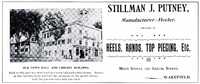 Old Town House, circa 1894
 "The advertisement and accompanying photo appeared in the Wakefield Souvenir of the Quarter-Millennial Celebration of the Settlement of Ancient Reading in 1894, and shows the 1834 Town House more than 20 years after it was moved from the Lower Common to the corner of Main and Salem Streets in 1873, and a third story was added. The building was occupied by Stillman J. Putney, a manufacturer of heels, rands and top piercings for footwear. In a synopsis of the business, it was noted that the 'cheapness of footwear' in the 1890s was the result of the manufacturing being divided into specialties. Putney manufactured heels in his factory which was 'fitted up with machinery of the most improved type, driven by an 8-horse power engine.'"
-
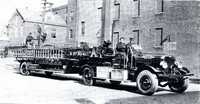 Ladder 1, 1928
 "Driver Henry Russell, Chief Fred Graham and Tillerman Harry Parker (on the rear tiller) displayed Ladder 1 near the old fire station shortly after its arrival in Wakefield. The Town purchased its first aerial truck in 1928 and put it into service in December. Touted as the area's first aerial, the double-bank 75-foot truck was purchased from the Seagrave Company at a cost of $15,500. According to the 1928 Town Report, 'this machine is of the latest type having several new features which serve to increase the efficiency of same.' It was equipped with a 'water gun having a 3-inch hose,' a 75-foot, two-section wooden ladder with a spring-assist raising mechanism, and 304 feet of ground wooden ladders. The truck had an 80-gallon water tank with 200 feet of 3/4 inch booster hose, and a 75 gallon-per minute pump, as well as a life net, stretcher and an oxygen tank for 'resuscitation work.' The 1928 Seagrave replaced a 1914 Peerless city service type ladder truck that was subsequently sold by the Seagrave Company to Pascoag, Rhode Island for a cost of $1,600. Ladder 1 was taken out of service on June 15, 1954 after it was involved in a collision with Engine 5 at the corner of Pleasant and Lawrence Streets. Both pieces of apparatus were responding to n alarm from box 423 for a fire at 35 Lawrence Street, and both were declared losses. American LaFrance loaned Wakefield a 1932 Mack 85-foot aerial ladder truck that had been previously owned by the Bangor, Main Fire Department. A new American LaFrance 85-foot ladder truck was put into service in May 1955."
-
 Vernon Market, Vernon Street, circa 1946
 "Lifelong Wakefield resident Louis Pasquale opened Vernon Market at 161 Vernon Street on November 22, 1946. A veteran of the US Navy, Pasquale served in the South Pacific aboard the battleship USS Indiana, and made plans to realize his dream to open his own 'modern' market soon after his discharge. Before joining the Navy, he had gained experience working at Henry's Market in Waltham. Vernon Market was a 'complete' food store with shelves stocked with 'the best brands of meats, groceries, and canned goods.' The store offered delivery and was self-service, with the exception of the meat counter. Customers could also order their groceries over the phone by calling Crystal 0276-R. On its 5th anniversary, local news reports noted that families in the 'four sections of town and Lynnfield' patronized the store in the building that featured the 'latest in lighting and self-service counters.' The Vernon Market continued to operate as a neighborhood store until October 31, 1970 when the Pasquales signed a five-year lease with the Richdale Group. In July 1975, Louis and Nancy Pasquale were given approval to alter the building from a two-family to a four-family dwelling. The space occupied by the store was converted into two three-room apartments."
-
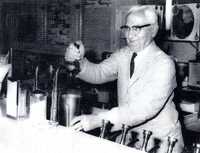 Charles Klapes at the Colonial Spa, circa late 1960s
 "Charles John Klapes, a native of Theologos, a suburb of Sparta, Greece, opened the Colonial Spa on Saturday, August 28, 1920. Charles left his home in Greece in 1906 and was ready to start his new business in 1920. According to his son Alexander in a tribute to his father upon his passing, Charles looked at the property in the middle of winter to see it in its 'least attractive state.' He l;liked what he saw and brought his young wife Aphrodite to Wakefield where they eventually raised their children: John, Michael, Mary, Alexander, Constantine (Charles), and Benjamin. According to the ads which appeared in the Wakefield Daily Item on the two days prior to the opening in 1920, the ice cream parlor and soda fountain includes a 'spacious area in the rear half of the store for the ice cream, tables,' and 'eight tables for the ladies.' The 'Spa' as it was called in the newspaper reports, also carried a large line of candies, tobacco, cigars and cigarettes. The opening was very successful, and 'the new fittings and attractive window displays, with orchestral music in the evening, brought many visits and good patronage.' The Colonial Spa continued solely as an ice cream parlor until the 1930s when a luncheonette was added. In addition to the luncheonette, the Colonial Spa evolved over the years to include a book section, an extensive candy section and a giftware section. The luncheonette closed in 1983. The Colonial Spa remained a family owned business until its closing in December 2000 following the death of Alex Klapes."
-
 Crystal Lake, great New England hurricane of 1938, September, 1938
 "The Great New England Hurricane of 1938 is reported to be one of the deadliest and most destructive tropical cyclones to impact New England. The storm, estimated to have made landfall as a Category 3 hurricane on Long Island on September 21st, moved quickly through New England with the eye of the storm passing over western Massachusetts. The Blue Hill Observatory registered sustained winds of 121 mph and a peak gust of 186 mph, the strongest hurricane-related surface wind ever recorded in the United States. Most were caught unaware of the severity of the storm, due to the unusual speed of the storm and the lack of sophisticated monitoring equipment. In addition to the tens of thousands of homes that were destroyed or damaged by the storm, more than 20,000 electrical poles were toppled and an estimated two billion trees were downed in New York and New England, affecting over 35% of New England's total forest area. In Wakefield, hundreds of trees were uprooted in all areas of the Town, shingles and entire roofs were blown off buildings and homes, including the roof of the Nichols Ice House at the head of Lake Quannapowitt. Windows were blown out at several homes and buildings, including the Central Garage and Taylor Hardware Store, and chimneys were destroyed, including the newly-repaired chimney at the Methodist Church on Albion Street. The damage was so great that the church building was later condemned."
-
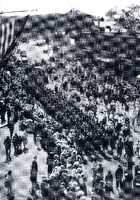 Company A leaving for Fort Devens, August 26, 1917
 "Richardson Light Guard, Company A, 6th Regiment departed Wakefield for Fort Devens, and eventually to the battlefields of France, on Sunday morning, August 26, 1917. The Company had been notified in mid-August that their Regiment was among those which would be 'broken up' and combined with other to make 'war strength units.' To boost the morale of the soldiers, Capt. Edward Connolly received permission on August 23rd to take the company to Wakefield for a farewell visit before the 'dreaded changes occurred.' The Public Safety Committee hastily arranged a celebration and sendoff, which were held on Saturday and Sunday, respectively. The company arrived in Wakefield at 4:52 p.m. on Saturday, and its soldiers were back at the State Armory for their sendoff parade at 10:30 a.m. the following day. A 'touching' farewell was given by Father Florence J. Halloran of St. Joseph Church before the short parade to the Upper Station. Lieutenant Colonel John J. McMahon, Captain Connolly's predecessor as Commander of Company A, was the Chief Marshall of the parade. He was joined by Captain S.H. Brooks; Lieutenants Jeremiah Creedon and Edward E. Hickey, both formerly of Company A; Lieutenants F. Manning Hartshorne, Edward O. Proctor, Paul H. Taylor and E. Hazen Walton, all of whom were from Wakefield and had received officers' commissions at Plattsburg. The line of march also included the State Guard Company, led by Lieutenant John H. Downing; the Grand Army Veterans, led by Commander J. Warren Poland; the Spanish War veterans, led by Commander Francis H. Marion; Police Chief James J. Pollard and his 'platoon' of police; and Lurvey's Lynn Cadet Band."
-
 Ricky Nelson, Pleasure Island Showbowl, June 22, 1962
 "'Teenage idol' Ricky Nelson was just 22 years old when he made his first New England appearance at Pleasure Island when it opened its fourth season on Friday, June 22, 1962. According to regional news reports, an estimated 10,000 parents and children attended the park's opening day festivities which included two shows by Nelson, at 2:00 p.m. and 9:00 p.m. at the outdoor Showbowl. Nelson also performed two shows on Saturday and Sunday. Because of Pleasure Island's popular Showbowl, Nelson was the first celebrity to stay at the Lord Wakefield Hotel which opened for business six months earlier on December 15, 1961. Local newspapers reported that the star's stay at the hotel was a 'fairly well-kept secret,' with Police Chief Merritt Wenzel and 'his men keeping a close watch over the hotel during the weekend to prevent any teenage uprising.' In addition to Ricky Nelson, the Showbowl attracted national and international performers. Pleasure Island's second season, in 1960, opened with the Three Stooges who brought in nearly 20,000 guests during its first week. The park opened with Chuck Connors in 1961, with 57,000 guests during his six-day appearance. Pleasure Island hosted many local personalities such as Rex Trailer, Major Mudd and Wakefield's own Gene Jones with Community Audition shows, as well as national stars including Duke Ellington, Dinah Washington, Dave Brubeck, Gene Krupa, The Four Freshmen, Troy Donahue, Robert Horton, Jimmy Dean, Don Ameche, Joe Ross, Fred Gwynne, Clayton Moore, Lassie, Frank Gorsham, Cesar Romero, Michael Landon, Jerry Mathers, Johnny Crawford, Fess Parker, Dion, and many more. Beyond the Showbowl was the former Greenwood Station, which was dedicated on July 6, 1885 and relocated, restored and renamed the Goldpan Gulch Station for the park's narrow-gauge Pleasure Island and Western Railroad which was owned and operated by Edaville Railroad.
-
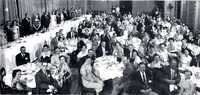 WHS 25th anniversary reunion, June 25, 1955
 "Members of Wakefield high School, Class of 1930 attended their 25th anniversary reunion at the University Club in Boston. Among the class members at the head table was Dr. Elizabeth V. Upham (sixth from left), who later became a teacher, administrator and Dean of Girls at Wakefield High School. According to the Debater, the high school yearbook, Elizabeth was an assistant artists on the yearbook staff, a traffic officer, a library assistant, and the Corresponding Secretary of the Inter Nos Club, which was in its second year of existence in 1930. Although the yearbook noted that "Lib" planned to attend an art school or Jackson College, she went on to graduate from Tufts University in 1934 and received her Master's Degree in Education two years later. She started teaching at Wakefield High School in 1936, in a career that spanned more than 40 years. As Dean of Girls, Dr. Upham was the class adviser for the Inter Nos Club for several decades, as well as countless other activities. She went on to become a major benefactor of the Lucius Beebe Memorial Library, leaving a substantial portion of her estate in a trust 'to be used for the purchase of books and materials, particularly in history, literature, and the social sciences.' Among others at the reunion, at the table directly in front of Dr. Upham, were John and Giovaninna (Benedetto) Volpe. Jennie, as she was called, was a graduate of the Class of 1930. Both John and Jennie were raised in Wakefield, with John leaving home at an early age and graduating from Malden High School in the mid-1920s. Following her graduation, Jennie was a registered nurse at Winchester Hospital and at Bellevue Hospital in New York. The couple married in 1934. At the time of Jennie's class reunion, John was the Massachusetts Commissioner of Public Works. He went on to serve as the first administrator of the Federal Highway Administration in 1956 and as Governor of the Commonwealth of Massachusetts from 1961 to 1963 and again from 1965 to 1969. He served as the US Secretary of Transportation from 1969 to 1973 and was appointed US Ambassador to Italy where he served from 1973 to 1977. Among the other class members who may have been at the reunion were Winnifred Ashenden, Sigmund Szydlowski and Constance Doyle."
-
 250th anniversary celebration parade, May 28, 1894
 "The H.M. Warren Post No. 12, G.A.R. participated in the 250th anniversary celebration of the settlement and incorporation of the Ancient Town of Redding on Monday, May 28th, a day proclaimed as Settlers Day. Approximately 40 members of the Post were on board the float that held four cannons, one at each corner. The barge was 'appropriately decorated with flags and bunting, in charge of Quartermaster A.D. Merritt.' The Commander was Stephen W. Lufkin and Walter Hunt was the bugler. According to the back of the photograph, the identifications are as follows: '(front row, left to right) Maj. John M. Cate, W.J. Bridges, (unidentified), S.W. Phillips, N. Cowdrey, (next two unidentified), W.J. Mansfield, G.K. Walton, Oliver Walton, G.H.S. Driver, W.O. Giles. (Second row, left to right) John Day, (unidentified), D.P. Rolfe, John Day, (next two unidentified), S.W. Lufkin, Dion Malone, in front with the rifle. Mr. Brownell, standing at right of cannon." The name of John Day is listed twice in the identifications."
-
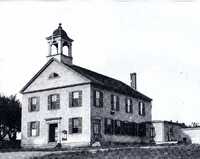 South Reading Academy, circa 1870s
 "The South Reading Academy, located on Academy Hill where the Lincoln School was later built, was built around 1828-29 'under the auspices of the Baptist denomination.' The 2-1/2 story wood frame structure was three bays wide with a front-facing gable roof. Its main facade had an entrance centered in a recess that was framed by pilasters and an entablature. The front gable was fully pedimented, with a decorative shingle pattern at its center. According to the Genealogical History of the Town of Reading, Mass., the academy, established in 1829, was intended as an Introductory School to the Theological Seminary at Newton, 'although it was open to others.' The land and buildings were reported to be obtained by private subscriptions of the people of South Reading. While the school flourished for many years, the theological students were 'withheld' and the corporations was without funds, leading to the school being closed and the building returned to its original owners. The building and land were sold to Assistant Principal William Heath and Burrage Yale, who sold them to the Town in 1847 to be used by the newly created high school. The town stopped using it as a school in 1871 when the new high school on Lafayette Street was built. In 1891, it was moved to its present location at 7 Foster Street where it has served as home to a chapter of the Grand Army of the Republic, a Methodist church congregation, and the Fraternal Order of Eagles, among others. It was severely damaged by fire in the 1970s, but was restored to be used as a commercial building. The building was listed on the National Register of Historic Places in 1989."
-
 Laying of the Beebe Library cornerstone, March 17, 1922
 "In 1916, the townspeople purchased a lot at the corner of Main and Avon Streets for $16,000. That same year, Junius Beebe, son of Lucius Beebe, donated $60,000 toward the construction of a new library building to be built in memory of his parents, Lucius and Sylenda. Construction on the building was delayed by World War I, and several modifications and land purchases were made before work began and the cornerstone was laid on March 17, 1922. Because building costs rose after the war, Junius Beebe and his family increased their donation to $200,000. The cornerstone was laid in a ceremony at 3 p.m. on a cold and raw Friday afternoon 'in the presence of several hundred people.' School children were dismissed early and church bells were rung throughout the Town as a reminder of the important event. During the ceremony, Building Committee member Harris M. Dolbeare outlined the contents of the copper box which was placed beneath the cornerstone: photographs of Lucius Beebe and Junius Beebe, copies of newspaper articles about the Beebe family, copies of the Boston newspapers and the Wakefield Item, circulars and printed materials regarding the campaign to raise money for the site, photographs of public buildings in Wakefield, and a statement written by committee member Dr. Richard Dutton and read to students the day before the event. Speakers included Committee members Dolbeare and Dutton, and Winfield S. Ripley, Jr., Chairman of the Library Trustees. Lucia Beebe, daughter of Junius Beebe and granddaughter of Lucius Beebe, smoothed over the cement that workers placed on the cornerstone using a silver dowel [i.e. trowel] provided by the contractor, James E. Nelson Company. The engraved dowel [i.e. trowel] was found in a basement on Daniel Road and donated to the library in 2009. The building was dedicated on April 15, 1923."
-
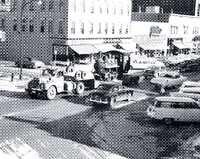 Wakefield Square, February 25, 1959
 "An antique 20-ton locomotive traveled on the back of a truck through downtown Wakefield just two weeks after the Greenwood railroad station made the same trek to Pleasure Island. The Davenport 2--6-0 narrow gauge engine was hauled by flatcar from the bayous of Louisiana and arrived at the B&M siding on the Junction railroad tracks near Broadway in mid-February. The engine was reported to be from the last of the narrow-gauge roads and had been used to haul sugar cane from the fields at Reserve, the largest sugarcane refinery in the United States in the early 20th century. It was believed that the engines was built around 1900. The locomotive was among several Canadian and American locomotives that were part of Pleasure Island's Engine City exhibit, which included the 216-ton 'old No. 3713'. That engine had been brought out of retirement from Fitchburg. According to local news reports, approximately 4,500' of spur track was laid from the B&M's old Newburyport branch to the Pleasure Island site especially for the locomotives to travel over the rails. Pleasure Island, which opened to the public on June 22, 1959 lasted for 11 seasons, closing on Labor Day weekend 1969. Nelson Blount, who owned Edaville Railroad, moved his Engine City exhibit from Pleasure Island to North Walpole, NH in December 1961. From there, the collection went to Bellows Falls, VT which became Steamtown USA. Some of this collection, which started at Pleasure Island, can still be seen at Steamtown national historic site in Scranton, PA."
-
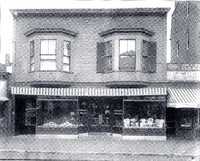 McMasters store, 424 Main Street
 "McMasters Store was owned by Lauren L. McMaster, whose occupation was listed as newsdealer and stationer in the 1918 street and telephone directory.. He and his wife, Helen, lived at 36 Yale Avenue. According to an ad in the same directory, the store was a subscription agency which did developing, printing and enlarging, in addition to selling newspapers, periodicals, stationery, souvenir postcards and Dennison's goods. The ad also listed the availability of electric lamps, Columbia Grafonolas and records. Lauren McMaster was born in Wakefield on July 4, 1881, and died on October 10, 1943, as the result of an automobile accident. Following his graduation from Brown University in 1904, he was employed in the wholesale dry goods business and lived in Chelsea until the loss of his home in the great conflagration of 1908. He returned to Wakefield and became associated with the leading news and periodical store, becoming the owner in 1915 where he remained until 1933. He became the manager of the local office of the Western Union Telegraph Company until April 1943, when he became associated with the Malden and Melrose Gas Light Company. McMaster was active in the community, serving on the Board of Selectmen as Chairman in 1921, as an organizer and first president of the Wakefield Chamber of Commerce, and for many years was active in the Rotary Club where he served as President in 1926-1927, and with the Baptist Church and Y.M.C.A. He was active in the Masons and served as Master of the Golden Rule Lodge in 1929, and as District Deputy Grand Master of the Melrose 7th District in 1931 and 1932."
-
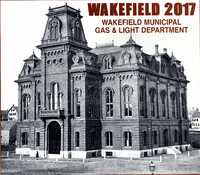 Wakefield Hall, circa 1870s
 "The new Town Hall was built on the former Noah Smith lot, at the corner of Main and Water Streets. The land and $30,000 were donated by Cyrus Wakefield in 1868 to build a soldiers' monument or memorial hall to honor South reading citizens who answered the call to arms during the Civil War. Because of his generosity, the Town of South Reading voted in 1868 to change its name to Wakefield. Governor Alexander H. Bullock approved the name change on June 30. A day of celebration was held on the anniversary of American Independence, July 4. The new Town House, referred to as Wakefield Hall, was dedicated on Washington's birthday, Wednesday, February 22, 1871. When completed, it is reported that Cyrus Wakefield had quadrupled his original donation. The dedication was held at 2 p.m. with speeches by Cyrus Wakefield and a host of other notable citizens. After the key to the hall was presented, the ceremony ended and a banquet was held in the upper hall for the 400 guests in attendance. Toasts were given to the President of the United States, Dea. Francis Smith, the State (sic) of Massachusetts, the Merchants of Boston, the Clergy, 'Our Manufacturing Industries,' Dr. Solon Richardson (who gave a gift of $1,000 for the furnishings), the Public Schools, the Farmers of New England, and the State Printer. According to the Wakefield Inaugural and Dedicatory Exercises, in his response to the toast to the farmers, Dr. George B. Loring of Salem 'touched upon the Woman Suffrage question, and as for 'woman's rights', he said, 'I go for them.' Cyrus Wakefield died suddenly, at the age of 62, on October 26, 1873, two and-a-half years after the Town Hall was dedicated."
-
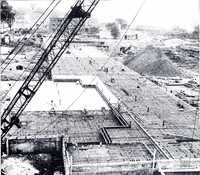 Wakefield Memorial High School, Main Street, circa 1954
 "Construction on the addition to the high school started soon after Town Meeting voted to acquire the land south of the school. The school was dedicated on February 22, 1955."
-
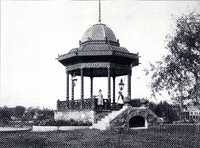 Bandstand, circa 1890
 "The Park Music Pavilion, referred to as the Pagoda, now the Bandstand, was built in 1885 as part of a $10,000 bequest from Cornelius Sweetser which provided money for park purposes. The bandstand 'of unique and elaborate design' is said to have resembled a pavilion in Brighton, England, and had hanging lanterns to illuminate the area. The structure, made of wood and dressed fieldstone, replaced a bandstand that was 'a square, wood platform, breast-high, the under part latticed in,' and could easily be transported from one part of the Common to another. It stood in the middle of the 'bigger end of the Common, near the big flagpole.' Just prior to its demise, the old bandstand stood on the upper Common, opposite Lafayette and Crescent Streets."
-
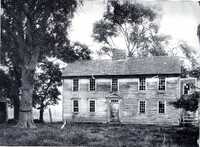 Old Swain house, Vernon Street, circa 1890s
 The old Swain house was 'situated on the easterly side' of Lot End Road, now Vernon Street, just north of Lowell Street. Although some reports indicate it was built in 1720, it was most likely built around 1752 as the homestead of Dr. Thomas and Hannah Swain on land first granted to Jeremiah Swain in 1652. Thomas, born in 1705 and died in 1759, was the fourth generation to live on the land. He was the son of Dr. Benjamin Swain (1669-1749), grandson of Major Jeremiah Swain (1643-1710), and great grandson of one of the Town's early settlers, Jeremiah Swain (1615-1658). After Dr. Thomas Swain, the home was occupied by three more generations: his son Dr. Oliver Swain, who was followed by Deacon Oliver Swain and Thomas Swain. All seven generations are buried in the Town's Old Burying Ground. By 1865, the home was owned by Dr. David Batchelder. The Old Swain House, later called the Batchelder House, was destroyed by fire on December 15, 1899."
-
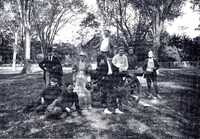 Cannon on the Common, circa 1890s
 "Although it is unclear to local historians when the cannons were placed on the upper Common, now the Veterans' Memorial Common, generations of Wakefield residents have admired, and often climbed on top of the artillery that is on the Common today. The cannon pictured may be the Civil War-era cannon that graced the Common for many years until it was removed for restoration many years ago. The cannon reportedly was never returned to the Common. The two cannons presently on the Common are 1876 Breech-Loading Howitzers which were last refurbished by the Town in 1994."
-
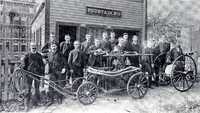 Fountain Engine No. 3, Crescent Street, circa 1886
 Fountain Company No. 3, a volunteer company which was not part of the Fire Department, was organized on August 23, 1875. The hand tub used by the company was built by Increase S. Hill sometime around 1835, and was purchased by Aaron Butler from Salem in 1873. The tub was painted red with a small portrait of the Yale Engine House Fire of 1859 on the side. First housed in a stable in rear of Main Street, opposite Albion Street, the hand tub was moved to Crescent Street, between Water and Lincoln Streets, in 1885. The small building was behind the Henry F. Miller & Sons Piano Company factory, which can be seen in the picture. Fountain No. 3 disbanded around 1888 and was replaced by Volunteer Hose No. 2. Fountain No. 3 hand tub was sold to Reading for $125. The new company used the building to house the Rumsey hand-drawn hose carriage the members had purchased at a cost of $275. It is reported that the building was later moved to Water Street, across from L.B. Evans, where it became home to a cigar store. Fountain No. 3 volunteers included (left to right) William M. Hanley, Benjamin C. Flockton, W.J. Dennett, William E. Parker, Charles H.T. Brown, S.E. Ryder, William L. Block, Albert D. Cate, J,.C. Gould, H.A. Simonds, William E. Cade, Charles Whiting, Irvin E. Phipps, Charles H. Pope, Arthur Skinner and James P. Goodhue."
-
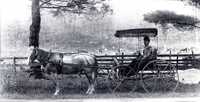 Geneva Joy Heath, 1895
 "Geneva Joy (Lord) Heath lived at 617 Main Street with her husband, Elroy N. Heath. The couple married on September 29, 1886 and moved into the home soon after. Although there is little information about Geneva other than working as a clerk in the Town Clerk's office in the 1920s, there is a wealth of information about her husband. A native of Springfield, Elroy moved to Wakefield around 1879 and worked in Boston where, according to the 1883 publication Commerce, Manufactures & Resources of Boston, Mass., he was a 'Manufacturer of Heath's Improved Indexes and Letter Files.' He held several patents for his inventions, including two for letter holders and filing systems, which created 'a convenient combined index book and table, by means of which any name or subject may be found with the utmost rapidity.' A bicycle enthusiast and a member of Wakefield's bicycle clubs in the early 1900s, Elroy had two other patents, one which improved the propelling mechanism for bicycles 'and the like', and another which created an improvement for carrying packages and drawings for 'velocipede' riders. According to the patent application, 'My improved package-carrier resembles a hammock, and I have devised hammock-suspending devices by which it may be readily swung from the handle-bar or some other suitable part of the machine.' A velocipede was any of the several early bicycles with pedals on the front wheel. He moved his business from Boston to Room 5 in the Wakefield Block in 1884, and his patented files, indexes and advertising calendars were reported to have a widespread reputation. In addition to his business and hobby, Elroy was a member of the Sons of the American Revolution and was active in the Town as chairman and secretary of the Wakefield Municipal Light Board and as a member of the Finance Committee. The picture of Geneva was most likely taken at the couple's summer home, Idyll Farm in Springfield. Elroy died in 1909, and the farm was sold in 1911."
-
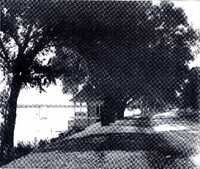 Wright's Boathouse, Lake Quannapowitt, circa 1893
 "The lakeshore on Main Street was not part of the town's common land before 1885; rather, the southeast corner of Lake Quannapowitt and Main Street was dotted with buildings, such as John Aborn's Shoe Shop, which was said to be between the lakeshore and Main Street, Mrs. Courtney's hand-laundry, several houses, and Wright's Boathouse. The structures were eventually moved as a result of the bequest of Cornelius Sweetser to create public parklands, and the 1882 act of the legislature to allow cities and towns to lay out public parks within their limits. The boathouse, built by Albert J. Wright around 1886, remained on the lakeshore until 1893 when it was moved to a location behind his 228 (now 202) Main Street home. Its removal may have also been prompted by the extension of the street railway line along lakeside, which opened on May 26, 1894. Born in 1838 and educated in Boston, Albert J. Wright 'shipped before the mast' aboard the clipper ship Radiant in the mid-1850s where he sailed to San Francisco, making the passage in 135 days. In his travels he learned the tinsmith's trade in Michigan, and returned to Boston in 1858. He read law in the office of the City Solicitor, attended Harvard Law School, and was admitted to the Bat in 1861 to practice in all the courts of the Commonwealth by Chief Justice Shaw of the Supreme Court. He received a commission in 1863 as paymaster in the United States Navy, and after the Civil War he entered the printing business where he and his partner, under the name of the W@right & Potter Printing Company, became the authorized state printers. He was active in many organization, including the Loyal Legion of the United States of America, the Grand Army of the Republic, the Kearsarge Association if Naval Veterans, the Bostonian Society and the Harvard Law School Association, the Boston Yacht Club, of which he was a charter member, and the Eastern Yacht Club of Marblehead, among others. He also served as a member of the General Committee of the 250th anniversary celebration of the Town in 1894, serving as a member of two subcommittees: Procession and Out-Door Music, and Reception and Entertainment of Guests."
-
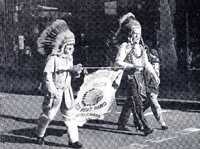 Wahpatuck Tribe 54, Improved Order of Red Men's Band, circa 1950s
 Organized on October 8, 1909 in Grand Army Hall, the Wahpatuck Tribe 54, Improved Order of Red Men was a popular and welcome sight at parades and celebrations during the 1930s, 40s and 50s, including the annual 4th of July parade. According to the History of Wakefield (Middlesex County) Massachusetts, compiled by William E. Eaton and History Committee in 1944 to celebrate the Town's 300th anniversary, the Wahpatuck Tribe 54 was the largest such chapter in the Commonwealth. The Wahpatuck Tribe 54, Improved Order of Red Men Band was known throughout the East Coast, participating in parades and competitions throughout the region. The original Wahpatuck Tribe 54, Improved Order of Red Men Band split up in the 1950s, according to newspaper reports. Its original drum was discovered in the basement of the Americal Civic Center in 1994 and has since been donated to the Wakefield Historical Society. The Tribe had its headquarters at 33 West Water Street. Descended from the Sons of Liberty, the Improved Order of Red Men is a patriotic fraternity chartered by Congress which had trace its origins back to 1765. According to the national organization, the non-profit-organization is devoted to inspiring a greater love for the United States of America and the principles of American Liberty. After the War of 1812 the name was changed to the Society of Red Men and in 1834 to the Improved Order of Red Men."
-
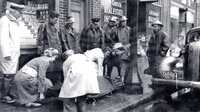 Civil defense drill, June 7, 1942
 "In the days and weeks after the attack on Pearl Harbor on December 7, 1941, Wakefield residents rallied together to help by volunteering at the American Red Cross headquarters at the Lincoln School, becoming air raid wardens and joining the medical defense unit as part of the Wakefield Committee on Public Safety, and/or collecting scrap metal, rubber and paper through the Wakefield Salvage Committee. In addition to the Wakefield Municipal Light Department-sponsored (now Wakefield Municipal Gas & Light Department) school for air raid wardens, hundreds of local residents were trained in civil defense and what to do in case of a 'red alert.' As the men were registering for the draft at the Lafayette Building (now the Town Hall) or enlisting in a branch of the armed forces, local women were trained in first aid, canteen work and motor transport. One such civil defense drill was conducted by the Fire Auxiliary Department on a rainy Sunday in June on Main Street, across from Oak Street, in Greenwood under the watchful eyes of Fire Chief Fred Graham (left) and Firefighter Arthur Goodrich (center). In addition to the local efforts, more than 1,600 Massachusetts women, including approximately 70 from Wakefield, joined and trained with the Massachusetts Defense Corporation under the jurisdiction of the Massachusetts Committee on Public Safety. The Wakefield Company of the military organization was trained for duty to serve as volunteers in the local Civil Defense agency as air raid wardens, drivers, communications personnel, canteen workers, medics, chemical detection personnel and as emergency fire fighters."
-
 Wakefield Common, circa early 1860s
 "According to documented history, Wakefield has always had common lands since the first division of land among the early settlers. A special committee was selected in 1727 to lay out the 'ways and watering places' through the Common, and a vote was taken in 1742 that required that land remain unfenced and that parish land 'never be disposed of for any other use whatsoever, without the consent of every freeholder in the parish.' The trees on the 'upper' Common, now the Veterans' Memorial Common, at the right, were planted in the mid-1800s by a 'band of public spirited residents.' who viewed the opportunity as a 'general neighborhood celebration.' Both the upper and lower Commons were unkempt and uncared for, with water coursing through the center, forming a pool of water referred to as Ken's Pond, named after a blacksmith who had a shop on the west side of the Common. In 1859, the Common was drained and graded and, in 1860, the townspeople accepted a committee report and authorized the fencing of the public Common at an estimated cost of $700. The final cost to erect a fence at the Common was $636.75. On May 1, 1871, the Town voted to purchase land between the 'old Common' and Lake Quannapowitt to extend the Common, and authorized the Town Treasurer to 'hire a sum, not to exceed $19,600 for a 10-year term.' In 1883, the townspeople accepted a $10,000 gift from the will of Cornelius Sweetser which was to be 'used and expended in furnishing and beautifying a public park.' At the left of the picture stood the Third Meeting House of the First Parish, the Town House (both not shown), the brick Yale engine House, and a blacksmith shop on the lower Common."
-
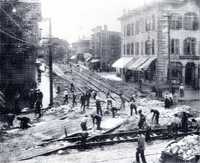 Albion and Main Street, 1902
 "The success of the street railway system led to double-tracking of the rails from downtown Wakefield to Melrose in 1901, and on Albion Street in 1902. According to news reports, the double-tracking on Albion Street was 'a difficult proposition, for many elm trees that had stood for decades had to be removed. As in the case of Main Street it was evident that a busy thoroughfare was no place for the thrifty growth of shade tress.' It went on to state that paved streets, concrete sidewalks, trolley wires, street railway feed lines, telephone wires, etc. were 'not conducive to the growth of such trees. One after another of these old trees have gone down and have yielded to the march of progress.' The Wakefield & Stoneham Street Railway Company was formed in 1889 and received its charter in May 1892. The two-mile route from the Post Office on Main Street at the corner of Albion Street (former Kingman Block) to Farm Hill in Stoneham began operations on August 14, 1892. The system experienced rapid growth, and eventually became a four-direction electric street railway system which enabled riders to travel to Lowell, Lawrence and Haverhill to the north; Malden, Chelsea and Boston to the south; Lynn, Salem, Beverly and Gloucester to the east; and Woburn, Winchester and Medford to the west. The original Wakefield and Stoneham Street Railway Company and other similar companies eventually merged until all became a part of the Boston & Northern Street Railway System, the Bay State Company, and eventually the Eastern Massachusetts Street Railway Company. The line was discontinued on July 6, 1929."
-
 Leeds Ice Cream Company, Vernon and Lowell Streets, circa 1930
 "Leeds Ice Cream Company was located on the northwest corner of Vernon and Lowell Streets beginning in the early 1930s, soon after the road was widened with the 'permission' of the County Commissioners, and the Town's first traffic signal was installed at the intersection in 1928. The ice cream stand was built on property once occupied by John Sweetser and later by Dr. Robert Cushman. Leeds Ice Cream Company later became Kydd's Ice Cream, stand, a popular stop for many in the 1950s and 1960s. The site is now a gas station."
-
 Aerial view of Wakefield, circa 1936
 "This aerial view of Wakefield, taken sometime around 1936, provides a look at Main Street in the downtown area. Main Street runs horizontally through the center of the photo, and shows several buildings that are no longer standing, including Wakefield High School (later called the Atwell Building) at the bottom right, the old Wakefield Town Hall near the center of the photo, the Miller Piano Factory behind the Town Hall, the Wakefield Building with its top floor, the buildings which housed the Wakefield Rattan Company (later the Robie Industrial Park) on Water Street near the top right of the photo, the stores and homes that stood on Main Street before they were razed during the 1940s, and the Methodist Episcopal Church on Albion Street that was torn down in 1938. The photo also shows the L.B. Evans' Son Co. Shoe factory on Water Street, the railroad that at one time traveled to Peabody and Newburyport, and the lot of land that would eventually house the Post Office next to the Lucius Beebe Memorial Library."
-
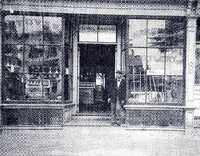 Daniel Goss & Co., Main Street, circa 1870s
 "Daniel Goss operated a heating and plumbing business at the corner of Main and Mechanic Streets, now Princess Street, until 1885. Goss, along with Oscar Noble of Wakefield applied for a patent on January 22, 1880 for an invention to improve heating stoves, 'utilizing the heat to the greatest possible extent, thereby economizing fuel' which was granted as #225,484 on March 16, 1880. Among those in his employ was George H. Taylor, who joined him in the business just days before the patent was granted. Taylor became a partner with Goss three years later, under the firm name of Daniel Goss & Co. A year later, this partnership was dissolved when Goss moved from the town. Taylor remained in business at the corner of Main and Mechanic Streets, 'doing a large and successful business for himself.' The building was the site of a fire on March 5th, 1907 that was classified as one of the town's major blazes. Soon after, he purchased the Wakefield Block at the corner of Main and Lincoln Streets and the store remained in business until June 1962. In addition to being a business owner, Taylor was a high ranking member of the Richardson Light Guard and was elected as a Major in the 'historically famous' 6th Regiment of Massachusetts Infantry. It was under his command that the Richardson Light Guard held the Number 1 position in the Massachusetts militia and its rifle team was the 'pride of the State' during the 1890s."
-
 Wakefield Memorial High School, Main Street, circa 1955
 "Planning for a new high school began in earnest in the late 1940s and early 1950s, with several sites and plans considered by the building committee, including the former Town Farm site on Farm Street, filling in a section of Hartshorne's cove on Lake Quannapowitt and building the school on Veterans' Field and Halls Park, and building an addition on land to the south of the existing high school on Main Street. The latter plan was approved by Town Meeting."
-
 Hood Farm, Pleasure Island 1959
 In the early 1950s, the late Wiliam S. Hawkes, publisher of Childlife Magazine, envisioned creating a family recreation center to be named Childlife World, similar to the Mother Goose parks throughout the country, such as StoryLand in North Conway, NH. On July 16, 1955 the amusement park industry would never be the same! Disneyland opened, and investors followed the trend leader. Childlife World became Pleasure Island when Hawkes and Marco Engineering of Los Angeles collaborated with Cabot, Cabot and Forbes to break out 168 acres of wetland from CC&F's Industrial Park along the edge of the new Route 128. Billed as Boston's answer to Disneyland, Pleasure Island opened on June 22, 1959 and was the second of three innovative theme parks built across America to mimic Disneyland. H.P. Hood & Sons (now Hood LLC) was the first company to sign a lease for what was officially an 'outdoor entertainment and merchandising center.' As a lessee, Hood signed a five-year contract with the first year's and fifth year's rent paid in advance, which helped underwrite the cost of the park's construction. H.P. Hood & Sons invested $500,000 in a second mortgage to Pleasure Island, Inc. plus $10,000 per year for its five-year lease. The Hood's 4.5-acre farm included a large red barn and silo, and a farm tractor that would draw a wagon-train down through the farm over a winding road. The trip took guests by sheep, cows, calves and a duck pond, as well as a cow barn, a maple sugar house where syrup was boiled and blacksmith's shop. H.P. Hood & Sons also sponsored the Gay Nineties Ice Cream Parlor and snack stands at the farm, lighthouse, juice bar at Goldpan Gulch, and pushcarts. Pleasure Island went bankrupt after its first season, only to become one of the top grossing parks behind Disneyland in the early 1960s. Hood left after season one and a new petting zoo opened in its place in 1960. In 1961, a giant three-story high 'Bozo the Clown' slide was attached to the silo. The park closed in 1969. A portion of Edgewater Office Park Building 500's parking garage and Colonial Point's parking lot are on the site of the former Hood Farm. Hood LLC's corporate office is located in Lynnfield MA, just one mile from its Pleasure Island Farm.
-
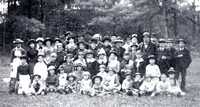 Greenwood Sunday School Outing Tasker's Grove, circa 1885
 Thought to be a Greenwood Sunday School outing, this gathering of children and adults enjoyed a day at Tasker's Grove, which was located at the west end of Linden Avenue, near Crystal Lake. The group included Rufus Kendrick, the large man with the moustache at the right in the photograph. A resident of Greenwood, Kendrick was the founder of the Wakefield Home Fire Protection Association, 'an independent volunteer association for extinguishing fires, working entirely with small apparatus, appliances generally ignored by fire departments, such as buckets, cans, Johnson hand force pumps, garden hoses attached to house faucets, or any appliance which could readily be made use of.' Hundreds of galvanized pails, milk cans, and Johnson pumps were located throughout the town; the first 'getting a stream of water' on a fire was rewarded with $1.00, and the first one to 'give the first still alarm' was rewarded with 25-cents. Kendrick also served as a fire warden and was well informed about trees and flowers, taking great interest in gypsy moths. As a member of the short-lived Wakefield Improvement Society, he planted a row of 52 trees, from 'Mr. Lee's store on Main Street north to the railroad bridge', which he called Soldier's Row in memory of those who served in the Rebellion.
-
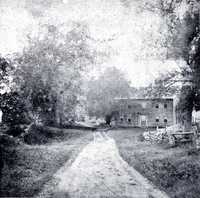 Hopkins House, Hopkins Street circa 1880s
 Owned by Ebenezer Sumner Hopkins, the 'old Hopkins place' was featured in the C. F. Richardson stereoscopic view around 1880. A photographer, Richardson was active in photographic circles, both locally and nationally, serving as president of the Boston Photographic Association in 1881, and as a correspondent for The Philadelphia Photographer, 'an illustrated monthly journal devoted to photography.' In addition to stereoscopic pictures of local churches and landmarks, Richardson also photographed private residents. The 1890 List of Taxable Polls and Estates for the Town of Wakefield lists Ebenezer Hopkins' property as a dwelling house, another house and an 'old home' on Hopkins Street, a shed, stable, two carriages, 15 cows and three horses, and nearly 40 acres of land on and west of Hopkins Street, Brook Street and Prospect Street, listed as orchard, meadow, tillage and pasture. The value of this personal property was listed as $900 and his real estate was valued at $7,000 which required him to pay a tax of $128.40. He was one of 84 Wakefield residents who had a Johnson hand force pump on his property which required him to sign a pledge that he would use it to fight any fire within one-quarter mile. Hopkins was born in South Reading (now Wakefield) in 1816 and died in Derry, NH in 1907. He lived most of his 91 years in Wakefield where he worked as a farmer. He and his wife, Mary Louisa Parker, had seven children. Their sons, Herbert and Joseph, were listed as farmers on the property, in the 1917-1918 street listing.
-
 Main Street at Crescent Street 1924
 The lot of land at the north corner of Main and Crescent Streets was once the location of the Second Baptist Meeting House. Built in 1836 and dedicated on January 20, 1837, the church was destroyed by fire on June 21, 1871. A new church was built on the other side of the Rockery, at the corner of Lafayette and Common Streets in 1873. The site was referred to as the Carter lot after the home of James H. Carter at 8 Park Street, which can be seen in the back center of the photograph. The home was later occupied by Samuel T. Parker. The Crystal Apartments were built soon after the photograph was taken, in 1924, by John S. Griffiths of 15 Chestnut Street. The apartment-house, said at the time to be the largest to be built in Wakefield, contained 21 suites.
-
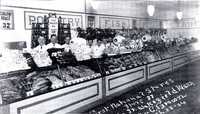 First National Store 447 Main Street, 1934
 The meat, poultry, pork and fish counter of the First National Store at 447 Main Street was well stocked with what seems to be every cut of meat, type of fish, and fresh fowl that was available at a retail market. Due to the re-numbering of Main Street, the original First National was located to the right of the present-day Colonial Spa when facing the building. A past edition to this historical calendar featured a look at the store's produce section, which began art the far right of this photograph. Meat manager Carl H. Brown and store manager Lloyd F. Curtis moved Store #37 to a new, more 'commodious' location across Main Street on February 1, 1940. Its new location at 456 Main Street (now 404 Main Street) was in the new brick building which replaced the Walton Block. Parking was available in the rear of the building and customer could enter from Mechanic (Princess) or Lincoln Streets as well as from Main Street. The new 'self-service' store was 52' x 120' with wide aisles. The meat and product sections were located to the left of the store, with the dairy at the right and the groceries in the center aisles. The basement contained storage areas and groceries, refrigerated areas for produce and fruits, and all refrigeration. It is interesting to note that the First National Store opened its new 'super-market' on the same day in 1940 as the A&P market at the corner of Main and Centre Streets.
-
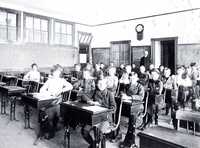 Franklin School February 1903
 These Franklin School students were the first to occupy the new school at the corner of Nahant and Traverse Streets. Planning for the new school started two years earlier, in 1900, when Town Meeting voted to study whether an addition to the existing school building on Franklin Street would be enough to address the overcrowded conditions. For the School Committee Report for the year ending January 31, 1900, the committee stated, 'The residents in the Franklin Street district are also asking for better accommodations, and their request is reasonable. They have been patient and long suffering. At the present time, all children above the fourth grade are obliged to attend either the Hamilton or Lincoln schools; the present building is entirely inadequate to the needs of the district.' In April 1901, Town Meeting voted to build a new eight-room school building, and that $30,000 dollars would be raised and appropriated to purchase the land and erect the building. When the new school opened on September 9, 1902, 240 student were in attendance, 30 more than anticipated, with more expected in the following days. According to the School Committee Report for the year ending January 31, 1904, 'For the relief of the new Franklin building, which can be repaired and put into commission again.' The old Franklin School, near the corner of Franklin and Nahant Streets, was eventually demolished.
-
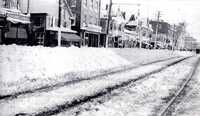 Winter on Main Street circa 1900s
 The east side of Main Street looking south was blanketed with significant snow in the early 1900s. The photograph shows the shops, houses and commercial buildings, most of which are no longer standing, as well as a street railway car that stopped to pick up passengers near Richardson Avenue. Buildings pictured just beyond the street car in the distance (and moving up Main Street) are the old Richardson Light Guard Armory that was destroyed by fire in 1911, the Hodkins Building, the old Cutler Bros. Grocery & Grain destroyed by fire in 1911, the old Town Hall razed in 1958, the Taylor Building with its fourth floor and Mansard roof intact, the Walton Building razed in the late 1930s, and many houses and small stores.
-
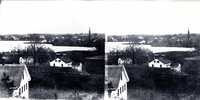 Stereograph, circa 1870s
 "This stereograph was taken from 'the hill south of Prospect Street and east of Fairmount Avenue, looking east.' It appears to have been taken before the building of several icehouse on the shores of Lake Quannapowitt, specifically the icehouse owned by Boston hotel owner J. Reed Whipple and John G. Morrill on the Col. James Hartshorne's meadow in the 1890s. Note the style of house along the lakeshore, as well as the third meetinghouse of the First Parish Congregational Church which was razed in 1890."
-
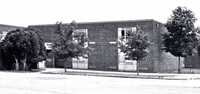 Atwell School circa 1980s
 "The Atwell wing of the Galvin Middle School was built following the devastating fire that destroyed the original Willard B. Atwell Building in December 1971. The original Atwell Building was built as the high school in 1923, later becoming the junior high school for grades seven, eight and nine when the 'new' Main Street high school was built in 1955, and eventually returning to its use as part of the high school when the junior high school, now Wakefield Memorial High School, was built in 1960. Following the 1971 fire, high school students in grades nine through 12 attended double sessions on Main Street until the existing high school on Farm Street opened in September 1974, the same time the 'new' Atwell Building opened for grade six students. Junior high school students returned to Main Street that same year, and in 1991, the junior high school was named to honor General John Rogers Galvin. Grade five students began attending classes in the Atwell Building in 1988 to alleviate overcrowding in the elementary schools.
-
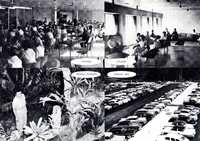 American Mutual, 1959
 "There were more than 20 varieties of palm trees, most over 20-feet tall, banana trees and rare species of plants in the garden area of the American Mutual building. Soil and humus were brought in from Florida and the rock gardens were constructed of Florida coral rock formations. An electronically-controlled rain and temperature system simulated tropical conditions at all times. The light court and gardens were designed by the building architect and the garden was created and planted by Mulford and Bert Foster of Orlando, Florida. Mulford was the consulting tropical botanist for the Arnold Arboretum and the Smithsonian Institute."
-
 Stereograph, Main Street, circa early 1870s
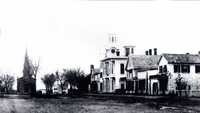
 "Taken as a stereograph by photographer C.F. Richardson, this picture shows Main Street looking north. In the left of the pictures is the 3rd meetinghouse of the First Parish Congregational Church which was razed in 1890. To the right of the church in the picture is the parish house and the 1834 Town House which stood on the Common until it was moved to the corner of Main and Salem Streets by J.M. Cate in 1873. The Yale Engine house is to the right of the old Town House. The bandstand had not yet been built. Along Main Street, from the center of the picture, is the brick Benjamin Wiley house, the Universalist Church, Day's bake house owned by Hosea L. Day, the Italianate style building which later houses the Citizen and Banner, a market, and Edward Mansfield's grocery store. The pictures also shows Main Street as it looked before the Rockery (1885) and the horse trough were built."
-
 Senior play, November 1927
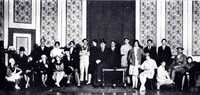
 "The Class of 1928 presented H.V. Esmond's witty farce, "Eliza Comes to Stay" on November 22 and 23. According to reports, both performances were 'well attended by appreciative audiences.' Lead roles were played by Milledge Crouse, the Honorable Sandy Verrall Lucia Buckle, Eliza; Jeannette Learoyd, Lady Elizabeth Pennybroke; Harold Decker, Alexander Stoop-Verrall; Fred Garvin, Herbert; Sandborn Caldwell, Montague Jordan; and Nita Tucker, Vera Lawrence. Other parts were played by Beatrice Seldon, Mrs. Allaway; Viola Hovey, Madeline Marmon; Lester Simpson, Ronnie Trezise; Rita Neagle, Bertha Bates; Helen Salipante, Peg des Jardins; Bessie McLellan, Maggie; Dorothy Ricker, Ethel; Carolyn Woodman, Jenny; Harry Iram and William Bradford, Porters; Staff members included Lawrence Gardiner, business manager; Walter Sherman, stage manager; Rowland Whittet, property manager; Kathryn Dutton, wardrobe mistress; and Hope McCloskey and James Cotter, publicity. Miss Hicks was the coach. Between acts, Emery Marshall sang a solo, Ellen, Madeline and Winifred Ashenden dances, and Boit Brannen played a violin solo. The High School Orchestra, directed by C. Albert Jones, played several 'pleasing numbers.'"
-
 Herrick Buick, 472 Main Street, circa 1947
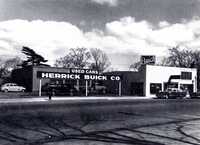
 "Herrick Buick at 472 Main Street was incorporated in 1945 when Fred Herrick, Sr. of Melrose purchase the Wakefield Buick Company and the building in which it was located. Herrick had previously served as Manager of the company for 10 years and had been associated with Buick for more than 28 years. When he purchased the company he became the 'appointed Buick dealer' for Wakefield, Stoneham and Reading. Herrick Buick expanded its services throughout the years, becoming the 'largest volume dealer' in its district. The Buick-built Opel Kadett line was added in 1966. In addition to the showroom for new and used car sales and service on Main Street, Herrick Buick also purchased the Avon Supply Building in 1968 at the corner of Avon Street and North Avenue as an additional showroom. The company also owned a separate automobile and truck body repair shop on Broadway for its expanded service department. Herrick Buick closed on January 31, 1974."
-
 Franklin School, circa early 1900s
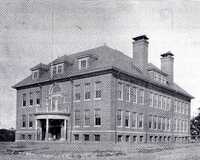
 "The Franklin School was built in 1902 on Nahant Street to replace the wooden schoolhouse at the intersection of Nahant and Franklin Streets. The eight-room brick school, designed by Harland A. Perkins, was built at the northwest corner of Nahant and Traverse Streets on land that the Town purchased along with a portion of an adjoining lot that they 'deemed necessary' for the project. The cost to build the school and purchase the land was $30,000, which the Town voted to pay in sums of $1,500 per year for 20 years. Construction began in 1901 and the school as ready for the first day of school on September 8, 1902. The Town originally appropriated $1,000 to furnish the school, which provided 42 desks and chairs for each of they five rooms they intended to use on opening day, for a total of 210 seats. When approximately 240 students arrived at the school, Superintendent Thompson when 'hustling about the town hunting up surplus seats and desks in other school houses, borrowed more where he could get them and set men to work furnishing a sixth room.' Miss McCormick, a resident of Boston and a teacher at the Greenwood School was telegraphed at her home to take charge of the extra room at the new school. She was able to do so, as the Greenwood School as not yet completed by opening day. The Superintendent and his workers stayed on the job until dark and resumed their work at 5 a.m. to ensure that the sixth classroom was ready for the second day of school. The buildings was enlarged in 1926 which doubled its room capacity."
-
 WWI sendoff, August 26, 1917
 "Less than 24-hours before sending the 'boys' of Richardson Light Guard Company A, 6th Regiment to fight in World War I, thousands of residents greeted the Company at the Center Station late in the afternoon on Saturday, August 25th when they arrived by train from Ayer via Boston. A reception was held late that evening in the armory, from 7:30 to 8:30, with dancing from 8:30 to 11:30 p.m. Crowds lined Main Street the following morning, August 26th 'well before 10 a.m.' to support the Company as they marched to the Upper Station from the armory. After a short parade down Main Street to the Common and up Chestnut Street, the company 'stood at ease in the drive in the rear of the Upper Station while wives, parents, sisters, brothers, sweethearts and friends bid tearful farewell to the boys in khaki who volunteered to go out and 'do their bit' for the cause of Democracy and to guard the safety and honor of their country. There were more wet eyes than dry eyes in the great crowd that pushed forward at the end of the march for the last leave-taking.' Family members and townspeople bought flags from local merchants which they waved as the train departed the Upper Station on North Avenue."
-
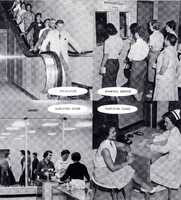 American Mutual Life Insurance, 1958
 "The Boston-based American Mutual Life Insurance Company opened its 'ultra-modern' home office on July 14, 1958. Formerly located at 142 Berkley [i.e. Berkeley] Street in Boston, the company began negotiating with the Town in 1954 to construct its $2 million home office along a 40-acre tract of land on the shores of Lake Quannapowitt. The building, designed by Chester Lindsay Churchill of Boston and New York, was 'strikingly modern in every detail.' Special features, touted by the company in its employee pamphlet, included an employee center, complete with a cafeteria and full kitchen facilities on the lake side of the first floor of the building to provide lunch and 'coffee breaks' for more than 800 people. Other areas included a store, a chapel with a 'massive colored-glass window' from France, an employee lounge overlooking the lake that was furnished with 'modernistic and comfortable furnishings,' an electronic data processing unit off the main lobby, a personnel clinic with a full-time nurse, banking facilities provided by the Wakefield Trust Company where employees could cash their checks, an engineering research center which allowed loss prevention to develop controls, and a complete audio system that broadcast messages to all areas of the building and played music at various times throughout the day. The employees were also able to have routine physicals and check-ups at the clinic. The most impressive features of the building were the glassed-in tropical gardens - two on the first floor that extended up through the first and second floors, and a third on the third floor."
-
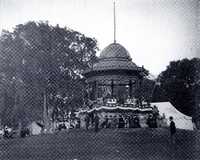 Wakefield Park, 1894
 "Wakefield Park, known as the Common, was the site of sporting, social and musical events on Settlers' Day, May 28th, the second of three consecutive days set aside to celebrate the Town's 250th anniversary. According to the Proceedings of the 250th Anniversary of the Ancient Town of Redding, 'dynamite salutes and the ringing of bells announced to sleepers that Settlers' Day was on...Tents and booths arose as if by magic in the park and vacant lots in the center of town. Fakirs, refreshment vendors and souvenir[sic] were seen and heard on every hand.' The day included a parade and visits to historic sites, as well as a concert on the bandstand at 1:30 p.m. that featured the Salem Cadet Band. The games began at 2 p.m. and included a one-mile race, 100-yard dash, boys' and men's bicycle races, tug-of-war between Wakefield and Veterans' teams, three-mile race, pole vault, three-standing jumps, a boys' doughnut race, running high jump, a dory race, and an event called running hop, step and jump. Most winners received silver cups or other silver articles. Cash prizes of $1 and $2 were awarded to the winners of the doughnut race and the boys' 100-yard dash. The winning team of the tug-of-war contest, the Veterans', won a $20 cash prize. A baseball game was held at 4 p.m., with a rowing regatta at 5 p.m. The Salem Cadet Band gave another 'fine orchestral performance from the Pagoda' beginning at 7 p.m., followed by pyrotechnics at 8:15 p.m. 'Before the delighted eyes of great crowds of witnesses flashed out a dazzling display of every kind, including colored lights, mines, rockets, Roman candles, bombs, shooting stars, and fiery serpents.' The schedule of events included a curfew at 9:30 p.m."
-
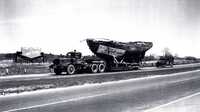 Route 128, May 1959
 "The 53' 20-ton, two-masted Newfoundland Swordfish schooner 'George and Freeman' moved from Portland, Maine to its permanent berth at Clipper Cove in Pleasure Island on May 5, 1959. The 80-year -old vessel had sailed with the Grand Banks fishing fleet before the turn of the century and was wrecked off the coast of Cuba. The schooner traveled the final leg of its journey along Route 128 which was a two-lane highway with a grass median strip in the Wakefield-Lynnfield area. The highway was eventually widened to accommodate the increasing number of cars and trucks. In addition to serving as a prop at Pleasure Island for 11 seasons, the 'George and Freeman' appeared in the movie 'Charlie' starring Cliff Robertson and Claire Bloom which was filmed at Pleasure Island during the off-season in 1967. Clipper Cove was a reproduction of a 150-year old New England fishing village, the place from which visitors embarked on two of the parks most popular attractions, the Wreck of the Hesperus and the Moby Dick rides. After entering Pleasure Island, visitors passed through the crescent shaped entrance to Clipper Cove that was outlined with barnacle-crusted anchors. The schooners 'ribs' can still be seen when the water is shallow in the area which was once Pleasure Island's Clipper Cove inner harbor."
-
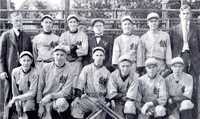 WHS baseball team, 1916
 "The Wakefield High School Baseball team held its first practice of the spring season on the park (Common) on April 6, 1916 under the direction of 'new' coach Bob Lane. According to the Wakefield Daily Item, the team made a 'fine showing' during the fall season, but 'with a coach, should make a better on and win the Middlesex League cup.' Team members included captain Eugene Sullivan, Thomas Dignan, Caswell Heustis, Frank Reid, John Kalaher, Warren Branch, Arthur McLeod, George Lane, Christie Barrett, and Maurice Donovan. The team also listed a Law and Clemons, without a first name."
-
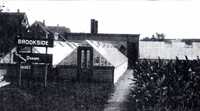 R.L. Pitman's Brookside Greenhouse, circa early 1900s
 "The Triplet Souvenir of Wakefield, Reading, and Stoneham, Mass. published in the early 1900s, identifies the greenhouse owned by R.L. Pitman as follows: 'The leading and largest business interest in Wakefield and vicinity representing the florist's line is the Brookside Greenhouses, located in the beautiful suburb of Wakefield called Greenwood. These were built in 1884 and Mr. R.L. Pitman has been the proprietor since the year 1894. The ground covered by the Greenhouses proper embraces about 9,000 square feet, while considerable uncovered acreage is utilized in the business'. Richard Pitman operated the greenhouse on land on the family's estate which was located at 840 Main Street. Richard maintained the greenhouse until his death in 1925. The estate, which was left to a distant relative, fell into disrepair. It was razed in 1945 and the land on which Brookside Greenhouses was located was developed into a 20-house subdivision by Ralph Morel of the Morel Building Trust of Greenwood."
-
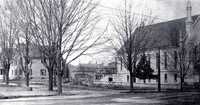 Corner of Yale Avenue and Main Street, circa 1908
 "Thomas Emerson first started his shoe manufacturing business at Lakeside, just north of Lawrence Street. He moved his operations to Albion Street, east of North Avenue, in 1859. He moved the Thomas Emerson & Sons shoe manufacturing company to Burrage Yale's tin shop at the corner of Yale Avenue and Main Street in 1863. The building was torn down in 1902, and in 1908, the Wakefield Young Men's Christian Association (YMCA) broke ground on the land to build its new building. The cornerstone was laid on September 16, 19098 and the building was opened on April 7, 1909. The ceremony for the laying of the cornerstone was 'unusually interesting' with music provided by the Boston & Maine YMCA band and speeches by the YMCA's state secretary Edward W. Hearne and the Honorable James Logan, Mayor of the City of Worcester. After the YMCA Auxiliary presented a donation of $1,000, a copper box was placed beneath the cornerstone. The copper box, which was sealed with solder, included historical sketches of the YMCA and YMCA Auxiliary, a list of contributors, three views of Wakefield, the names of town officials, the names of school committee members and teachers, copies of the April 12, 1906, May 17, 1907, and September 15, 1908 Wakefield Daily Item, a copy of the September 15, 1908 Citizens' Banner, portraits of President Lee and Secretary Conlon, portraits of Hattie Butterfield (first president), Sarah Evans Howard (treasurer), and Adelaide Coburn (first secretary), the program of the festivities, and the names of the members of the YMCA board. Separate openings were held on April 7 and 8, 1909 for the Auxiliary, contributors, high school students and the general public."
-
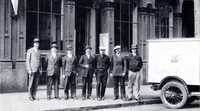 Wakefield Laundry, circa 1920s
 "Wakefield Steam Laundry, established around 1885 by Cox & Cheever, was located on Lincoln Street in the Taylor Building, the former Wakefield Building. Charles H. Cox became the sole owner and later sold the business to Clinton L. Newell. Ernest G. Willard, in the left of the picture with his staff and a 1920-era Ford Model T delivery wagon, bought the business from Newell in August 1909. The laundry, which became known as Wakefield Laundry, occupied a large part of the building for many years, eventually leasing the entire first floor, (with the exception of Taylor Hardware in the front of the building), as well as most of the rear basement and a one-story addition on the north side of the building. Willard was well-known for his attention to detail regarding the business and its equipment, including its fleet of vehicles. A large part of his business involved delivery to Wakefield residents and more than 4,000 customers in 13 area cities and towns. In its early years, the company utilized horse-drawn delivery wagons, later adding a fleet of 'motor trucks' which were meticulously maintained. In 1931, Wakefield Laundry added two light delivery trucks, bringing the number of trucks to seven in keeping with his 'desire to have the neatest-looking laundry delivery service in New England.' During the summer months, Wakefield Laundry continued its services to its vacationing customers by parcel post."
-
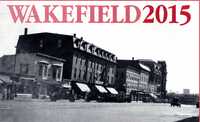 Wakefield Square, circa 1925
 "This picture of downtown Wakefield was taken on the corner of Chestnut Street looking south on Main Street. The buildings at the left side of the photo were razed in the late 1930s. Taking a look down Main Street, one can see L.L. McMaster newsdealer and stationer, DeCecca Food Shoppe, Boothby's, Smith's Drug Store, Curley Bros. Coal, Young Sign Studio, and other well-known businesses. The top floor of the Wakefield Block, which was removed, is still intact, and the Wakefield Town Hall, dedicated in 1872, is still standing. The cars in front of McMaster's are parallel parked, while others are straight."
-
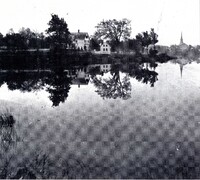 Main Street, Lakeside, circa 1880s
 "This photo, part of a stereograph, was taken along the shore of Lake Quannapowitt, looking south toward what appears to be Beebe's Cove. The fence at the left could have been part of the Beebe Estate and its farm, which consisted of flower gardens, melon patches, and substantial corn fields. The family also maintained a herd of approximately 100 milk cows and a number of stable horses. The third home of the First Parish Congregational Church can be seen in the background. Built in 1768, the church building faced west when built, but was turned to face south in 1859. The church building was considered to be too small and in need to repair; in 1887, the church members took the necessary steps to erect a new church on the same site. Farewell services were held on May 24, 1890 and the building was razed soon after."
-
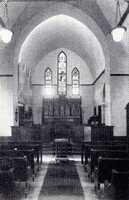 Interior of the Emmanuel Episcopal Church, Water Street circa 1890s
 Erected in 1881 at a cost of $5,000, the Emmanuel Episcopal Church was located on Water Street near the Center Depot, on the site that later became the L.B. Evans' Son shoe factory. Ground was broken in March 1881, with the first service held in August 1881. The chapel was enlarged in the early 1890s and remodeled into a 'homelike and attractive place of worship'. The interior was 'thoroughly renovated and refurbished' the following year, at an expense of more than $4,000. The new altar was a gift of Mrs. Daniel G. Walton. In the 1890s, the church was considered to be 'one of the prettiest and most convenient churches of its size in this vicinity'. The church was moved to the corner of Main and Bryant Streets through the generosity of Lidia Wright Pearson in 1900."
-
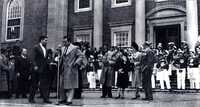 Movietime USA, Lucius Beebe Memorial Library, October 10, 1951
 "Attendance at movie theaters hit an all-time low in 1951 as people stayed home to watch television. At the urging of theater owners across the country, the movie industry embarked on a public relations campaign to bring people back into the theaters. Using the 50th anniversary of motion pictures as its theme, 240 actors, writers, directors and casting directors were divided into small groups and set out from Hollywood to 28 major cities and their surrounding cities and towns on a tour called Movietime USA. One group arrived in Boston and traveled throughout Greater Boston in a '15-car convoy of new DeSotos. The team, comprised of director Alfred Hitchcock; actors Dorothy Lamour, 18-year-old Debra Paget, Margaret Sheridan and Tom Breen; writer Welles Root; and MGM casting director Billy Grady arrived at Wakefield High School on Main Street. From there, 'the stars formed behind the high school band and drove to the Library where a crowd of 2,500 people were gathered to see their favorite screen personalities'. Greeting them on the steps of the library were Selectman Paul Lazzaro, (who presented Lamour with a bouquet of fall flowers), Herbert K. Noble and Raymond Dower; Town Clerk Charles F. Young; and Helen Carlson of the library staff. Hitchcock presented Miss Carlson and the library with a signed copy of the book, The Thirty-Nine Steps, from which his 1935 hit movie was made. Mistress of ceremonies Lamour introduced the team at the start of the 15-minute ceremony, noting that Wakefield's stop was the best and largest of the tour. Many in the crowd were high school students who were dismissed for an hour to see the celebrities. Newspaper reports noted that the 'high schoolers nearly prevented the departure of Miss Paget as hundreds of boys and girls closed about her car seeking a closer look'".
-
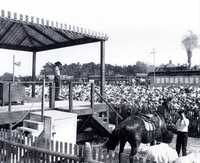 Chuck Connors, the 'Rifleman', Pleasure Island 1961
 "When Pleasure Island opened in June 1959, the main venue for entertainment was the Pepsi-sponsored Diamond Lil' Saloon. When new owners took over the park in 1960 and Pepsi opted out of its sponsorship, the entertainment venue switched to a new amphitheater known as the 'Show Bowl'. The venue attracted national stars, including Chuck Connors who played Lucas McCain in the Rifleman series from 1958 to 1963. According to the August 21, 1961 Billboard Amusement Business Magazine, more than 57,000 patrons paid more than $114,000 to see Connors in his six-day stand at the Show Bowl. Pleasure Island, it said, 'had the biggest week in its history because of good weather and Rifleman Chuck Connors...This broke all existing records for the park and topped the previous record held by the Three Stooges last year.' Television western-themed shows and Pleasure Island were sharing their heydays during this time period. Other cowboy stars, such as Wagon Train's Robert Horten, and Bonanza's Michael Landon performed at the Show Bowl, as did Boston's own Rex Trailer who was a familiar entertainer at Pleasure Island throughout the park's 11 seasons. In addition to playing the Rifleman, the 6'5" Connors, whose real name was Kevin Joseph Aloysius Connors, played basketball for the Boston Celtics and minor league baseball before landing an acting career. Pleasure Island closed forever on Labor Day weekend 1969. At Pleasure Island, children and 'children-at-heart' entered into a world that traditional amusement parks could not provide, where character actors continually put on a show and the entire park was a stage!"
-
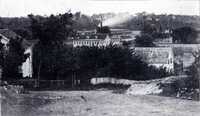 Wakefield rattan factory, circa 1880
 "This photo, taken from the top of Melvin Street, shows the wooden buildings of the rattan factory established by Cyrus Wakefield. Wakefield, for whom the town was named in 1868, brought his growing enterprise to South Reading in 1855 on land he purchased on Water Street. The site consisted of two mill ponds, one on each side of the road, and a few buildings used for manufacturing purposes. Nearly all the buildings, including the Stout Building pictured to the right of the smokestack, named for prominent citizen and large shareholder Richard S. Stout, were destroyed in the great fire of 1881. The company rebuilt and was said to be 'the largest business of its kind in the world."
-
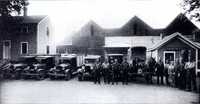 Morrill-Atwood Ice Company, 1933
 "The Morrill-Atwood Ice Company on Spaulding Street was one of the many ice houses in Wakefield which operated from the late 19th century to the mid-20th century. Owner John Merrill built an ice storage facility in 1878 on Spaulding Street and later joined forces with J. Reed Whipple, a Boston hotel owner, in 1890. They purchased a portion of Hartshorne's Meadow, now Veterans Field, and started supplying ice to Whipple's hotels and to other large users in Boston. Whipple sold his shares to Frank H. Atwood, a partner in Morrill's Spaulding Street ice house, in 1897. Whipple-Morrill exported its ice while Morrill-Atwood sold its ice locally. Atwood remained as the owner of both ice houses following Morrill's death in 1904. He left the wholesale ice business when he sold the Hartshorne Meadow ice houses to the Porter Milton Ice Company in 1919, and eventually sold the Morrill-Atwood company to Albert S. Anderson in 1926. Anderson started an electric ice manufacturing business in 1932 after several bad ice-harvesting years. He sold his business to the Metropolitan Ice Company of Somerville in 1945. Metropolitan eventually razed all the buildings, except one which was leased to Salvatore and Antonio Palumbo, who later purchased the property and operated their wholesale fruit and produce business there until the 1990s. The last remnants of the structure were demolished in 1988."
-
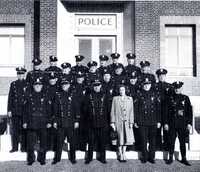 Wakefield Police Department, November 1950
 "The Town voted at the 1947 Town Meeting to purchase '22,404 square feet of land north of the Central Fire Station at Mechanic (now Princess) and Crescent Streets to Centre Street, and westerly toward Wakefield square and Main Street to the A&P Super Market parking lot and southerly to Mechanic Street' on which to build its new Police headquarters. The Concrete Construction Company of Chelsea was selected as the general contractor and ground was broken on January 17, 1950. Plans also included an 80' street in front of the new building, between Centre and Mechanic Streets, which the Selectmen named Commercial Street just before the department moved into the new, modern facility on November 13, 1950. The department was previously housed in the old Town Hall on Main Street. The Wakefield Police Department and the Chief's secretary, Mrs. Dorothy (McGrail) Hagan, posed for an official photo in front of the new building. Pictured (front row, left to right): Sergeant Walter E. Peterson, Lieutenant George B. DeRoche, Chief John G. Gates, Mrs. Hagan, Sergeant John M. Wenzel, and Motorcycle Officer John E. Martin. (Second row, left to right) Special Officer Morton V. Griffin, Patrolmen Winslow R. Smith, George F. Sheridan, Daniel J. Sullivan, Henry F. Galvin, and James T. McKeon. (Third row, left to right) Patrolmen Thomas Hennessy, Maximilian J. Ramocki, John T. Curran, Raymond J. Beane, and Peter A. Quinn. (Back row, left to right) Patrolmen John L. Clark, Harold J. Maloney, William F. Hovey, John F. Mahoney, and F. Charles Huppprich, Jr."
-
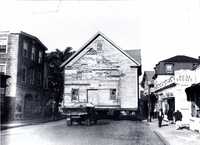 Moving of the Cutler barn, Albion Street, July 15, 1948
 "The Wakefield Post, Veterans of Foreign Wars purchased a barn at 6 Eaton Street, once home for 'Farmer' Allen and later to Nathaniel Cutler, owner of Cutler Bros. grocery and grain store. Known as the Cutler Barn, the structure was moved to 357 North Avenue by the VFW where it became its headquarters. Prior to the move, the barn had been relocated to the Lincoln School yard. On July 15, beginning at 4:30 a.m., the structure was placed on a 22-wheel truck, a process that took two hours. The move began at 6:30 a.m. along a route that took it up Main Street to Albion Street to North Avenue, passing by Mike's Bob Shop, at the left of the photo, and Bradley Real Estate, at the right. After a short delay due to traffic on North Avenue, the 'procession' moved to Chestnut Street where overhead wires were removed and tree limbs were removed from a large tree opposite 128 North Avenue to let the structure pass. At 9:35 a.m., the building arrived at its destination, a lot once occupied by Crescent Wet Wash Laundry which had been destroyed by fore a few years earlier. The structure was remodeled into the new home of the Wakefield Post, Veterans of Foreign Wars."
-
 Railroad marker, Cooper Street bridge, circa 1910
 The railroad marker in front of the Cooper Street Bridge in Greenwood indicated to travelers on the Boston & Maine Railroad that they could travel 60 miles to South Berwick, Maine and 107 miles to Portland, Maine along the Portland (West) Main Line which connected Boston with Lowell and points north. In the early 1900s, the rails carried more than 30 passenger trains in each direction every day. The Cooper Street Bridge in the background was built in 1903 by Joseph Ross, one of Boston's leading builders of wharves and bridges, including the bridge over the Merrimack River in Newburyport. The Town voted to appropriate $3,800 in 1902 to build the bridge to provide safe passage over the busy Boston & Maine right-of-way, primarily for students traveling to the newly enlarged Greenwood School on Main Street. It was one of two proposals voted on by the Town, the other being a spandrel-braced steel arch design with an option to be a six-foot wide pedestrian-only structure. The bridge is an early example of reinforced concrete arch construction 'notable for its substantial size, asymmetrical profile and the use of an unusual type of deformed rod for reinforcement'. It measures 100' long with a span length of 60' and is thicker at the west end by six inches. It was recently reported to be one of only two concrete arch bridges of its age spanning more than 50' still in use in Massachusetts."
-
 Charles F. Gilman, pharmacist, Railroad Street, circa 1894
 "Charles F. Gilman operated a retail pharmacy at 92 Railroad Street (now North Avenue) opposite the Upper Depot. According to Wakefield, Its Representative Business Men and Points of Interest, Gilman, a native of Maine, started the business in 1891 as successor to H.M. and L.W. Cross. His store was on one floor and measured 35' x 20'. He carried a complete stock of drugs, medicines and chemicals, 'besides toilet articles, cigars and choice confectionery.' The 1894 pubhlication also noted that prescriptions were compounded 'at short notice in a most skillful and painstaking manner' at a price that was uniformly moderate. In addition to pharmaceuticals and other items, Charles F. Gilman also sold bicycles. IN 1896, he also had one of four pay telephone stations in Wakefield where nonsubscribers could use the telephone at a cost of 15 cents per five minute conversation with any other subscriber on the Boston or Suburban Exchanges. The three other pay stations were located at E.A. Wheeler, Car Station in Greenwood; S.E. Ryder, Druggist on Main Street; and at the Town Hall. In 1918, records indicate that Gilman sold photo supplies."
-
 Wakefield DPW street line marker, Leo T. Gerrior, 1932
 "The National Conference on Street and Highway Safety published a Manual on Street Traffic Signs, Signals and Markings in 1930 which mandated that concrete street markings be painted white or black. In 1932, the Wakefield DPW's street marking crew, including Leo Gerrior, at right, was responsible for painting center lines, parking spaces, crosswalks, and restricted areas with two coats of paint. Gerrior, of Spring Avenue, a member of the DPW's Highway Department, was chiefly responsible for painting the traffic lines in the business district and 'much-traveled intersections' using the hand-operated equipment. On September 13, 1939, Leo Gerrior died after being struck by a car at the corner of Main and Bryant Streets while helping to prepare the street for tarring and sanding later in the day. Gerrior lived in Wakefield for 17 years and was employed by the DPW for 10 years. Before joining the DPW, he was employed in the machine department at the Heywood-Wakefield Company, and with CF Keyes of Albion Street as a painter. He left his wife and five children. His sixth child, a daughter, was born in February 1940."
-
 Main Street, May 23, 1959
 "This photo is from a series of photos taken by Bourdon Studios as part of a Pleasure Island pre-opening publicity campaign in the town's 'business district'. Note the street light, along with the stores that lined Main Street: Nagle's Drugs, Carol Ann's Card & Gift Shoppe, A&P, Santoro's Original Delicatessen, Adrian's Fabrics, and Crystal Fruit Exchange. According to a photo caption which accompanied the photo in the Wakefield Item, the six p[passenger carriage was pulled by a horse owned by Marshall Winkler of Cordis Street, who was also the driver for the publicity campaign. The carriage, which was owned by Pleasure Island, had been restored to be used at the park. The park opened its gates for the first time less than a month later on Saturday afternoon, June 20th. Approximately 4,500 guests and members of the press, radio and television got a special preview of the park at the invitation-only opening day. A special benefit premiere was held the following day, with all proceeds going to the Boys Club of Boston. Pleasure Island was open to the public at 10 a.m. on Monday, June 22, 1959. This year marks the 55th anniversary of its opening. By the sixth season, 50 years ago, it was under its third set of owners, Boston ventures, which operated the park for five seasons. They sold Pleasure Island to Fairbanks Amusements in 1969, closing that same year on Labor Day, after an 11-season run."
-
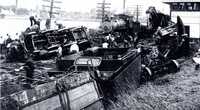 Train accident, Junction Station, 1917
 "An engine engaged in shifting empty p[passenger cars on the Salem Branch crashed head-on into an outbound Georgetown line freight engine just below the signal tower at the Junction Station on August 2, 1917. A fireman on the freight train was killed in the accident which occurred shortly after 10:30 p.m. According to news reports, the Salem Branch engine had just passed the crossover to the main line and the freight train was traveling at a 'good rate of speed' when the 'mammoth' engines crashed. The collision sent the freight engine hurtling from the tracks, sending it sideways, and pitching it onto its side beside the inward bound track. It was reported to be 'smashed in half' and 'knocked at right angles'. The box car and the coal cars were also damaged with iron from one of the engines imbedded in the Georgetown box freight cars. The passenger cars on the shifting (Salem Branch) engine remained on the tracks, although the forward car next to the engine was destroyed. The Salem crew jumped to safety before the impact. An Otis Street youth, Harold Anderson, walking home from a dance in Melrose, was among the first rescuers on the scene. Work continued into the next day, with railroad officials moving the debris so other trains could pass through the busy station. The rails below the signal tower where the engines collides were 'twisted like paper' and new iron was laid in the morning. Scores of local residents remained at the scene throughout the day."
-
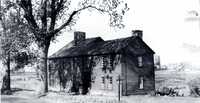 Col. James Hartshorne House, circa 1930
 "The Col. James Hartshorne House on Church Street is situated on land first owned by William Hooper, who in 1644 and 1650 bought two parcels of land on which he built his homestead. According to historical records, Hooper sold his land to Mary Hodgman in 1664. A wealthy widow at the age of 24, Mary married Thomas Hodgman and bought Hooper's land and home with her own name on the deed. Sometime between 1664 and 1680, the Hodgmans either moved the original Hooper house across the road or built a new one. They sold the house and land in 1725 to the Widow Patterson who occupied the house for 13 years, until her death in 1738. Her son sold the homestead in two parcels, the first, with a 'small house' to Jonathan Cowdrey in 1757, and the second, across the road to Samuel Poole in 1758. It was Cowdrey who is believed to have added to the house during his 34 years of ownership, as did the next owner, D. John Hart. Dr. Hart, a Revolutionary War surgeon, owned the house from 1792-1802 and used it as an investment, eventually turning it into an inn, called the Lafayette House. The Blue Lodge of Masons also met in a second-floor room during his ownership. Shoemaker Col. James Hartshorne purchased the house in 1803 and lived there until he died in 1870. His second wife, Mary, lived there until 1884. In 1890, J. Reed Whipple and John G. Morrill, bought the house and turned it into a tenement for Morrill-Atwood Ice Company workers. The Town of Wakefield voted at a Special Town Meeting on October 14, 1929 to purchase the home and meadow for $14,999 following a devastating fire that destroyed the ice houses in September. The Town also voted to restore the home as part of Wakefield's participation in the Tercentennial Celebration of the Massachusetts Bay Colony in 1930. The Col. James Hartshorne House Association was formed in July 1930, and incorporated in 1936 for the purpose of preserving and maintaining the house."
-
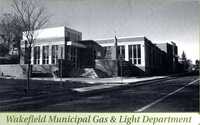 WMGLD Mark A. Delory Facility, 480 North Avenue
 "The Wakefield Municipal Gas & Light Department's Mark A. Delory facility at 480 North Avenue opened in June 2013 with a rededication and open house held on September 29th. The facility is named in memory of Mark A. Delory, a member of the Gas Division who lost his life on June 24, 2006. The former garage at the site was named in his memory in 2007. The facility is on the same site as the Citizens' Gas & Light Company which the citizens of Wakefield voted to purchase at Town Meeting in 1893. The Town of Wakefield assumed operation of the plant on August 4, 1894. In 1943, the light department physically expanded its operations with the purchase of 9-11 Albion Street office for its business office which had previously been located in the Town Hall and the Wakefield Savings Bank (now The Savings Bank). In 1951, the Town received permission from Town Meeting to erect a new building for a garage on its North Avenue site to replace the original structure. That building was razed in 2012 to make way for the new building. The business office moved from Albion Street in June 2013. The Mark A. Delory facility now houses all WMGLD operations."
-
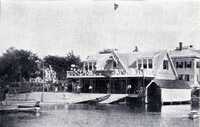 Wiley's Boathouse, 1897
 The original Wiley's Boathouse was located at the end of Spaulding Street in 1872, facing west in Hartshorne's cove. In 1887, Will Wiley built another boathouse at the end of Lake Avenue right on the shores of Lake Quannapowitt. This single-story boathouse was used by casual boating enthusiasts as well as members of the Quannapowitt Yacht Club who had their own pier at the Spaulding Street boathouse."
-
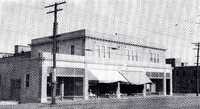 Hodgdon Building, 1923
 "The Hodgdon Building, located on the east side of Main Street just south of Water Street, was built at the same time as the new Wakefield High School (former Atwell Building) and the time of the extensive enlargement of Barry's Garage at the corner of Main and Armory Streets. To accommodate the new growth in the immediate area, Main Street was significantly widened during that time period."
-
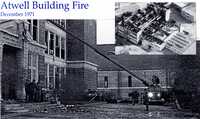 Atwell building fire, December 1971
 "Wakefield High School's Atwell Building on Main Street was gutted by a multi-million dollar fire which was first noticed by a passing call firefighter at 8:23 p.m. on Sunday, December 12, 1971. Flames were discovered on the first floor of the building in a north wall partition opposite the office of Superintendent of Schools, Dr. George MacArthur. It was believed the fire started in a classroom on the second floor above the accounting section of the school system's central office which adjoined the Superintendent's office. It traveled westerly through the floor partitions, over the area of the boys' lockers and into the auditorium through the ventilating ducts. Firefighters from 19 communities fought the fire throughout the night and into the early morning hours. The flames spread throughout the building, following air ducts and hollow passages until firefighters opened several ventilation holes in the roof to stop the lateral movement of the fire. The fire broke through the roof after midnight. Thousands of local residents came to the scene after being alerted to the fire by a news bulletin on a Boston TV station. Many students joined teachers, coaches and school officials in retrieving musical instruments and uniforms, sports equipment, audio-visual equipment and business machines which were in the back of the building. When the fire was finally out 20 hours later, 30 firefighters had been overcome by the acrid smoke and two more had been injured. The building was condemned the next day by the Building Inspector and a representative from the Massachusetts Department of Public Safety. A professional company from Arlington was hired to remove anything that was salvageable. Wakefield High School students attended double sessions in the high school's adjacent Memorial Building from 7 a.m. to 12 noon, and 12 noon to 5 p.m. This led to a 'modified' open study concept since no classrooms were available to be used as study rooms. Lockers were shared by two students and underclassmen were limited in their participation in varsity sports. The 1923 high school building was razed and the site where the school stood is now the Galvin Middle School parking lot."
-
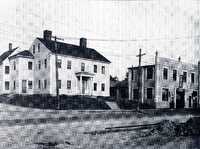 Abraham Sweetser House & Joseph Hughes Garage, Corner of Armory and Main Streets, circa 1920
 "The Abraham Sweetser house, at left, was the first home of Cyrus Wakefield. The house was built in the early 1800s by Sweetser himself, probably on land owned by his father, Paul Sweetser, a man who the Providence Rhode Island Journal said was 'the first to engage in the business of bringing ladies fine shoes from Boston to Providence.' The elder Sweetser was a 'considerable orchardist; he raised abundantly the best apples that were raised in the town. He owned a part of 'Walk Hill', a ridge of land then extending from-the-river, by the late Leonard Wiley's, southerly on Main Street, and easterly on Nahant Street, and all along its base, where, owned by Mr. Sweetser, was a continuous row of apple trees, which bore choice fruit, among which was a plentiful supply of the old 'Ben' apple.' The house was typical of the large, well-built dwellings of the period, with wide stairways, a large fireplace and brick ovens. Abraham was a shoemaker as were many of his neighbors, many of whom ran 'one-man shoe factories' in their homes. The house was razed in 1922 to make way for an addition to the garage. The Joseph Hughes garage was built around 1909 by Hughes who owned a small repair shop on Center Street. The garage, which measured 42' x 75' was determined to be inadequate when David Barry purchased it in 1919. It was Barry who razed the house and was responsible for building the tapestry-brick structure in 1922. Several more additions were added beginning in 1925. In later years it was home to W.T. Walker Oldsmobile, Sylvania's Semiconductor Division, and Verizon. The structure was recently razed to make way for CVS."
-
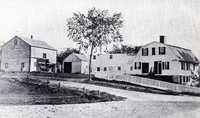 Leonard Wiley House, Crescent and Water Streets, circa 1890
 "The Leonard Wiley House, at the corner of Water and Crescent Streets was built somewhere around 1765. According to Lilley Eaton's Genealogical History of the Town of Reading, Mass. the farm land was originally owned by early settler Benjamin Poole, Esq. and later by his nephew, Jonathan Poole. Jonathan Poole's son-in-law Nathaniel Wiley inherited the farm and later passed it on to his son, Leonard. Leonard Wiley was born in 1791, one of eight children of Nathaniel and Sally (Poole) Wiley. He died in 1872. The farm was occupied by his heirs until the house was moved to 35 Bartley Street to make room for the Crescent House."
-
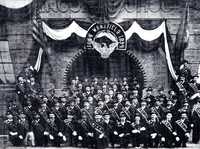 Hibernians at the Lincoln School, 1894
 "The Ancient Order of Hibernians, Division 26, was organized on August 1, 1868 as the Hibernian Aid Society with a membership of 33. Timothy Hurley was the first president. The organization became affiliated with the A.O.H., the oldest and largest Irish Catholic organization in the United States, on March 4, 1876. The Hibernians were among the many fraternal and civic organizations that participated in the 250th anniversary procession on Monday, May 28, 1894. The 85 members marched in the 1st Division of the procession which started on Main Street near the Wakefield residence, (now the corner of Main and Armory Street) up to Sweetser, Pleasant, Park, Main, Yale Avenue, Railroad (now North Avenue), West Chestnut, Park Avenue, Dell Avenue, Converse, Gould, Albion, Railroad, Chestnut to Main, where they passed in review before the Governor and other guests opposite the Town Hall on Main Street, at the corner of Water Street. Locally, the Hibernians were instrumental in the early growth of St. Joseph's Church. The members bought the buildings at the corner of Albion and Foster Streets in 1924, renovated it, and officially dedicated it on September 10th. It was said to be one of the largest and most successful fraternal gatherings ever held in Wakefield."
-
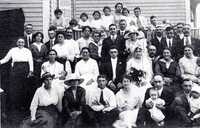 Dulong wedding party, August 1917
 "Believed to be the wedding party of Wakefield residents James Walter Dulong and Sylvia Anne Amiro, this photo may have been take by Wakefield historian, painter and photographer Joseph Payro. Payro was known for experimenting with different papers and developing techniques when printing his photos. The back of this photo contains the notation: 'Monox Bromide 15 ticks by the kitchen clock, 24" from the big lamp'. An additional notation indicates that the paper was 'four years old before being printed.' Although the Wakefield Town report of 1917 noted the marriage of James and Sylvia, there is no mention of them in the 1917 list of residents."
-
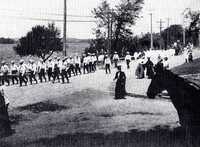 Volunteer Hose 2, Lakeside 1902
 "The 25-member company, formerly Fountain Engine 3, was reorganized as Volunteer Hose 2 on September 4, 1888. Shortly after reorganization, the members purchased a Rumsey four-wheel hand-drawn hose carriage by subscription at a cost of $275. The volunteer company, which for many years was an 'efficient, independent company', became a part of the Wakefield Dire Department following a Town Meeting vote in March 1892. Volunteer Hose 2 participated in many parades, including the dedication of the Soldiers and Sailors Monument in June 1902. The processions consisted of four divisions: the GAR post of Wakefield and vicinity; military; Wakefield High School cadets; and the fire department led by Chief William E. Cade which consisted of the Steamer Hose Company; the Hook & Ladder Company; Volunteer Hose 2; the Carter Hose Company and the Greenwood Hose Company. The parade route started on Richardson Avenue (across from the former Town Hall), and traveled along Main Street to Chestnut, Railroad (now North Avenue), Yale, Main, Crescent, Eaton, Pleasant, Salem, Main to Sweetser, where the divisions counter matched [i.e. marched?] to Salem Street. The participants were reviewed by Governor Crane as they passed by the pagoda (bandstand)."
-
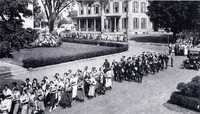 Wakefield High School Students, Common Street at Lafayette Street, 1923
 "Wakefield High School pupils. teachers, staff and administrators walked through the downtown from their former school on Lafayette Street (now Town Hall) to their new school on Main Street, on Jun 4, 1923. The parade was led by the Superintendent of Schools Willard B. Atwell, Principal Charles J. Peterson, Sgt. Ernest Munroe, and Miss Irene Laughton of the office staff, followed by the high school battalion drum corps. The senior class was next in line, followed by the junior, sophomore and freshman classes who walked four-by-four to the school. The parade route was lined with students from the elementary schools, with the exception of the Greenwood and Montrose Schools. When they arrived at the new high school, the pupils wen to the rooms assigned to them and then assembled in the auditorium where Principal Peterson explained the rules and regulations and read the new orders students were to follow. Following recess and lunch, the students were dismissed for the day, with 'lessons' beginning the following day. The 'new' high school was located on Main Street where the Cyrus Wakefield estate once stood and was built at a cost of $450,000. The original high school building was destroyed by fire in December 1971. The site is now the Galvin Middle School parking lot."
-
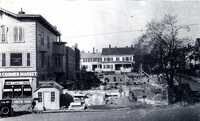 Corner of Main and Chestnut Streets, May 1, 1924
 "Once the site of the Town's fist church and meeting house, the land at the corner of Main and Chestnut Streets was also home to another landmark, Bessey Stable, until the structure was razed to make way for the Wakefield Trust Company. building. The property was purchased in August 1921 by Charles W. Hodgdon, the owner and manager of the Wakefield Theatre, with the intention of building a new playhouse. After the project was abandoned, the land was purchased by the Wakefield Trust Company. When the stable was torn down, local reports noted, 'The old stable has been a landmark for many years and marks another of the important changes of Main Street where an old wooden building ill be replaced by a modern structure.'"
-
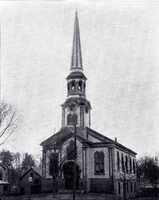 Unitarian Universalist Church, Main Street circa 1894
 "The Unitarian Universalist Church, the oldest existing religious building in Wakefield, had its beginnings on April 29, 1813, when seven South Reading men met at the Elm Street home of Col. Amos Boardman, a prominent local businessman and Revolutionary War Veteran. Joining him as founding members of the Universal Society in South Reading were Joseph Eaton, a grocer; John Rayner, a baker and Keeper of the Pound; Charles Emerson, and inventor and manufacturer Benjamin Goldthwait, a cobbler; Joshua Burnham, a clergyman; and Thomas Melborn, who is only referred to as being married to Joshua Burnham's sister. Meetings were held at members' homes or at the schoolhouse until they accumulated enough members and resources to build a Universalist Church. In 1839, the Universalist Society purchased a lot of land from John Rayner's widow, Mary, on the County Road, now Main Street, at the spot where the road divided. The Greek Revival-style building with its triangular pediment and four classical columns was dedicated on November 21, 1839. The original building was moved back 50 feet in 1859 and was raised, with the front portion of the church and steeple added. The style of the building remained unchanged into the 20th Century, with some interior and exterior alterations brought on by several fires in adjacent buildings. Major alterations occurred in 2008 when the church spire was removed due to serious structural issues throughout the steeple. The organization, founded as the Universalist Society and later as the First Universalist Society of Wakefield, became the Unitarian-Universalist Church of Wakefield when the two denominations merged in 1961. The church will celebrate its bicentennial year with festivities and a capital campaign to repair the steeple."
-
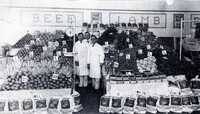 First National Store, March 23, 1934
 The First National Store at 432 Main Street was one of eight markets that served the Town in 1934, the others being Reid's Market, 77 Albion Street; Railroad Market, across from the upper railroad station; City Hall Market, 6 Water Street; Sperbers Market, 14 Water Street (which advertised that it sold full-strength beer and wine); Quality Grocers, 87-89 Albion Street; McCarthy's Market, 412 Main Street, Wakefield Fish Market, 3 Mechanic Street; and Orde's Fish Market, 109A Albion Street. First National, known by its acronym Finast and 'The First National', was incorporated as the Ginter Company in 1917. It changed its name to First National Stores, Inc. in 1925 when it was consolidated with the John T. Connor Company and O'Keeffe's, Inc. Finast was a retail supermarket brand that existed in the northeastern United States until being absorbed by Edwards and its Dutch parent Royal Ahold in the mid-1990s. Finast was originally based in Somerville, prior to its change to the Edwards name. The base was then moved to Windsor Locks, Connecticut.
-
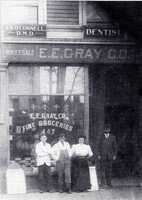 EE Gray Company, 447 Main Street, circa 1909
 "The Main Street store, E.E. Gray Company, was one of 25 branch stores of the E.E. Gray Importers, Wholesale and Provision Dealers of Boston located throughout Greater Boston and Massachusetts. The company also had three Boston stores, on Hanover, Blackstone and Union Streets. The company was established by Elmer E. Gray in 1885 at the age of 23. Within four years, he had built up a large trade and reputation as a commission merchant in butter, cheese, eggs, and live and dressed poultry, and supplied goods to dealers, restaurants, hotel[s] and families. He received his supplies directly from the producers and was able to sell them at the lowest market prices. According to Illustrated Boston, the Metropolis of New England, 'this representative and progressive house was established by Mr. Gray, who has built up a large trade and through his extensive connections controls a large business. Consignments of choice creamery and dairy butter, cheese and fresh eggs are received daily, and also live and dressed poultry. Promptitude and quick sales form the policy upon which the business is conducted and the stock is always choice and fresh. The premises are of ample dimensions for the requirements of the business and a force of clerks are kept constantly employed. Liberal advances are made on consignments and in all matters pertaining to this special line of trade Mr. Gray is prepared to transact business in a manner satisfactory to all concerned.' By 1915, his stores were selling kitchen items, including galvanized iron watering or sprinkling pot[s], children's aluminum mugs, window and door screens, and gardening supplies. In 1927, company officers organized a new corporation to acquire the necessary funds to extend and enlarge the business of the E.E. Gray Company. The company filed for bankruptcy in December 1930."
-
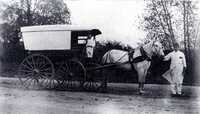 Curtis Bakery, circa 1890s
 "C.H. Curtis, 'caterer and dealer in plain and fancy crackers, ice cream, bread, confectionery, canned goods, etc.' operated his bakery at 430 Main Street. The business was established in 1888 and was regarded in the Representative Business Men of Wakefield 1894 publication as 'one of the most reliable enterprises of the kind in Wakefield, and those who have made a practice of dealing with this establishment speak of the even excellence of the goods offered, and the uniform courtesy extended to every customer.' The bakery consisted of a 50' x 10' building and a 35' x 20' bakehouse, and employed five skilled assistants. According to the publication, Mr. Curtis operated a large wholesale and retail business, specializing in 'weddings, parties, balls, and church fairs.'"
-
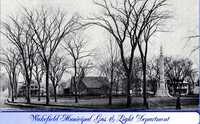 Wakefield's Upper Common, circa 1909
 "Now known as Veterans' Memorial Common, Wakefield's Upper Common was once the original public land created by the Town's early settlers in 1741. The Soldiers and Sailors Civil War Monument, at the right of the photo, was erected in 1902 as a gift from Harriett Flint. At its dedication on June 17, 1902, it was described as, 'The monument, aside from its own beauty, makes a striking picture with its background of rich green foliage and the blue waters of the lake beyond. It stands in the center of a triangle of lofty elms. Immediately in front, a bed of brilliant hued flowers gives a touch of color to the scene'"
-
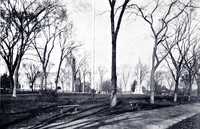 Wakefield Common, circa 1905
 "The upper Common, pictured shortly after the dedication of the Soldiers and Sailors Monument which occurred in 1902. Before the Town received a bequest from Cornelius Sweetser of $10,000 which stipulated that the money be used to improve a public park, the common as we know it was a bit run down, with debris from a nearby tin shop littering the area and a ditch running through the upper Common. The Town agreed to match the donation in 1883 and the common was transformed by the park commissioners. The end result was the draining and regrading of the Upper Common and the addition of new fences. In 1990, the Common District, referred to as the land between Lake Quannapowitt, Main Street, Common Street, Church Street, and Lake Avenue, was added to the National Register of Historic places. The Upper Common was officially named as the Veterans' Memorial Common in 2011."
-
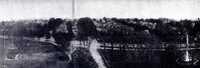 Church Street, Wakefield Common, circa 1905
 "Wakefield's upper and lower Commons are visible in the circa 1905 panoramic photo. It is interesting to note that the road forks, with the left side leading to Salem Street and the right side leading to Pearl Street."
-
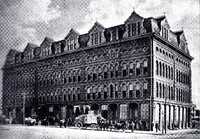 Henry F. Miller Piano Factory, circa 1894
 "The Henry F. Miller Piano Factory was one of three imposing buildings in the downtown area that were built in the 1870s. The building, located behind the Town Hall at Water and Main Streets, was the factory for the company's Boston, Philadelphia and Cincinnati showrooms. The company was established in Boston by Henry F. Miller in 1863. A musician, Miller was described as an inventive genius with great skills as a 'mechanician'. He was joined in the business by his five sons who moved the factory into the stately building in 1884. The company continued under the direction of Henry F. Miller, Jr. and his brothers after his father's death in 1884, and Henry F. Miller & Sons continued to produce high quality pianos made by master craftsmen until a decline in demand caused the company to discontinue its own piano line in the late 1920s. The company became a part of the Continental Piano Company. The Miller Piano Factory building was sold to William T. Curley, Sr. in 1930 and houses various businesses over the next 30 years, including a furniture store, several shoe manufacturers, and an antique store. The building was razed in 1960 to make way for the Surety Bank and Trust Company building."
-
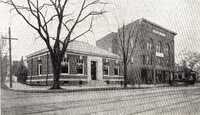 Main Street, between Chestnut and Avon Streets, circa 1905
 "The Wakefield National Bank, later the Wakefield Trust Company, purchased the Hannah S. Brown land at the northwest corner of Main and Chestnut Streets in the early 1900s, and erected the building in 1902. The bank, incorporated as the South reading Mechanical and Agricultural Institution in 1833, shared the building with the Wakefield Savings Bank, now The Savings Bank, from 1902 to 1924, when the Trust Company moved into its new building across Chestnut Street. the building on the corner of Avon Street was known as the Flanery Building, and later as the Odd Fellows Building. Erected in the late 1890s, a fire gutted the interior of the building in January 1997. The building was renovated and restored by The Savings Bank, which now occupies the building. The Mansfield, estate, now the Lucius Beebe Memorial Library, is pictured at the right."
-
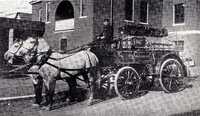 Firefighter William Tyzzer, circa 1906
 "The Wakefield Fire Department replaced its 1894 Abbot-Downing hose wagon with a 1906 American LaFrance combination chemical and hose wagon it purchased at a cost of $1,450. The horse-drawn wagon carried two 30-gallon chemical tanks and 1,900 feet of hose. During the eight years it was in service, the American LaFrance responded to several major fires, including the great Chelsea fire which destroyed nearly a quarter of the city in 1908, and the February 1909 fire that destroyed the First Parish Congregational Church. Other major fires included the 1907 fire at George Taylor's store at Main and Princess Streets, and the Cutler Brothers Grocery and Grain Store fire in 1911 at the corner of Main and Water Streets that destroyed several other businesses and buildings in the area. The Fire Department started adding motorized equipment in 1908 when it converted a second-hand touring car into a hose wagon, effectively ending its use of hand-drawn equipment. Additional motorized pieces of equipment were added, and by 1912, the American LaFrance combination chemical and hose wagon was reassigned to the Greenwood station. A Peerless chemical and hose wagon replaced the 1906 apparatus in 1914. The department's horses were no longer needed and were given to the Wakefield Municipal Gas and Light Department and the Department of Public Works."
-
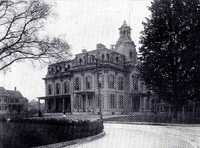 Wakefield High School, Lafayette and Common Streets, circa 1907
 "Wakefield dedicated its new high school 140 years ago, on the site of the former Parson Prentice House - the third parsonage in the First Parish - on October 10, 1872. The new school replaced the South Reading Academy, which was located on the site of the Lincoln School. The school was built just one year after the commodious Town Hall at the corner of Main and Water Streets (1871), and four years after the Town changed its name from South Reading to Wakefield (1868). A six-room addition was added in 1900, and the building remained in use as the high school until 1923 when a new school opened on Main Street. Renamed the Lafayette School, the building housed the Town's eighth grade until 1936. In 1937, the building was remodeled as part of a Works Progress Administration (WPA) project, and its distinctive Italianate features were removed, with the wood replaced by brick. The Lafayette Building was used for municipal and veterans' purposes until a fire at the 1871 Town Hall in December 1950 rendered that building inhabitable [i.e.uninhabitable]. In April 1951, Town Meeting voted to move Town equipment and records to the Lafayette Building. In subsequent years, Town Meeting voters voted against repairing or restoring the vacant Main Street Town Hall, and voted to move all Town offices to Lafayette Street. The old Town Hall was razed in October 1958. The Lafayette Building, now the William J. Lee Memorial Town Hall, has undergone renovations since the 1950s, including a major accessibility renovation in 1998."
-
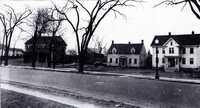 Main Street, circa 1952
 "In 1952, Town Meeting unanimously voted to purchase, or take by right of eminent domain, five parcels of land and their structures to enable the Town to build a new senior high school on Main Street, adjacent to the high school. The cost of the five parcels was reported to be $67,500. The owners were listed as Mildred Hawkes, Marjorie Cook, John Marshall, Jennie Willey, and Edna Brown. One house was later moved to the corner of Park Avenue and Prospect Street. The 1952 meeting lasted over three hours, with several votes taken during the evening. One article that was soundly defeated was to put an addition on the existing building to the west. Another defeated article included the building of a senior high school at the site of the Town Farm, (the current location of Wakefield High School). The 940 voters also voted to establish a 6-3-3 (elementary-junior high school- high school) school system. Initial plans also included the junior high school moving into the former high school building, later named the Willard B. Atwell School. The total to build a new school, with the purchase of the land, was said to be $2,130,500. The new high school opened in 1955 and is now the Galvin Middle School, with the exception of the Atwell wing of the school."
-
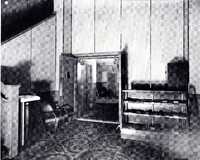 Princess Theatre, 1938
 "The Princess Theatre on Mechanic Street, now Princess Street, opened in 1912 in a building previously used for storage, and, at one time, had housed the Thomas E. Stapleton mattress factory. The theatre was owned and managed by Charles W. Hodgdon, who was also the manager-owner of the Wakefield Theatre on Main Street. The Princess Theatre underwent a major renovation in 1938, with the addition of a 'modernistic' main entrance (the previous entrance became the exit), a spacious circular-shaped lobby (with a 'light, airy dome slightly over 20' high'), lounging smoking and reception rooms for men and women (the men's and ladies' rooms were similar although the ladies' room was furnished more 'luxuriously'), wider seats, built-in aisle lights with dimmers in every second row of seats (which ended the ushers' need for flashlights), a spacious room for ushers, a ticket booth, an 'attractive' candy counter, an electrically-cooled drinking fountain at the foot of the balcony stairs, and wider, larger balcony staircases to make the accent [i.e. ascent] easier for older patrons. The theater was closed during World War II for lack of employees, but reopened in 1945. The Princess Theatre continued to operate until the 1950s. The building was later used for storage by Parke Snows, and was sold to C. Harry Olson, as part of a three-property deal, for nearly $50,000 in 1958. The building was occupied by various businesses, including the Nearly New Thrift Shop, until 1971 when it was razed."
-
 Harvard Knitting Mill, Albion, Foundry and Maple Streets, June 1913
 "Flatlock Operators at Harvard Knitting Mills used Flatlock machines which created a 'very strong, soft almost flat seam no thicker than the fabric itself'. The seam, patented on March 31, 1908 and introduced to the trade in 1913, was made in one 'operation' at a very high speed. The company touted its 'Harvard Mills (hand-finished) Underwear' with it's 'flat-lock single thickness seam' in national advertisements, with a disclaimer at the bottom stating that if a dealer didn't carry 'Harvard Mills', they undoubtedly carried the company's Merode brand, in the same attractive styles and p[rice. Established by Charles N. Winship and Elizabeth E. Boit in Cambridgeport, MA as Winship-Boit Company in 1888, the company moved to Wakefield's Taylor Building in 1889. Due to the success of their Merode hand-finished knit underwear, the company bought land at Albion and Foundry Streets in 1897, and a three-story building, with basement, was built on the land. The company continued to grow rapidly, with six major additions from 1901 to 1921. The popularity of knit undergarments started to decline in the late 1920s, and by the mid 1930s, parts of the buildings were rented out to other companies. Parts of the complex were sold, and in 1955, the main mill was sold."
-
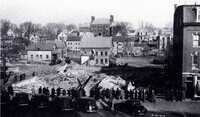 Southern corner, Main and Centre Streets, circa 1938
 "The downtown area of Wakefield was transformed in the late 1930s and early 1940s, with the razing of houses and brick buildings. The Gould Block, on the northern corner of Main and Centre Streets, was razed in the late 1930s and, like most of the older buildings, replaced with a one or two story 'modern' building that housed a variety of new and established businesses. The Cheney Block on the southern corner of Main and Centre Streets was home to Wakefield's first jewelry store, Cheney's, which also served as a periodical and newsstand. Mr. McMasters, who was well known for his newsstand, eventually bought the business. After the buildings within the block were razed, new one-story structures were built to house Nagle's Drug Store, Friend's Bakery, the Atlantic and Pacific store, and Russell's Electric. Boothby's (at the far right) remained intact while buildings on either side were razed and rebuilt."
-
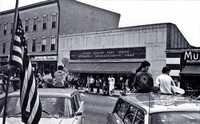 Main Street, between Princess and Lincoln Streets, 1971
 "Local residents gathered along Main Street to watch the Little League parade, which traveled from the Common to the Little League Field behind the former St. Florence Chapel on Del Carmine Street, off Water Street. It is interesting to note that the former Walton Block in the center of the photograph was occupied by the Post Office during the expansion of its current building at the corner of Main Street and Yale Avenue which began in 1970. After weather-related delays, the addition was completed and the Post Office moved from its temporary location in the First National Supermarket in late 1971."
-
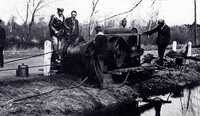 Tractor engine & hoist, March 1935
 "The Town of Wakefield was among the most active communities that worked with the CWA (Civil Works Administration, which was established in 1933 by the New Deal during the Great Depression to create manual labor jobs for millions of unemployed during the winter, until it ended in March 1934); and the WPA (Works Progress Administration, the largest and most ambitious New Deal agency which employed millions of unskilled workers to carry out public works projects, including the construction of public buildings and roads). As a result, several road and sewer projects were undertaken throughout the Town, including the relaying of water mains which employed 393 men, and the 'dressing up of the Town' at all the entrances into the community, with new curbing. Additional projects included adding cement sidewalks and widening streets. These may have been local contractors, public works employees, or WPA works involved in the operation that used the tractor engine and hoist to operate the dragline."
-
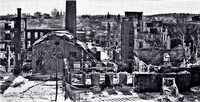 Robie Industrial fire aftermath, February 1972
 "An arsonist set a number of devastating fires in the early 1970s, including the 10.5 acre Robie Industrial Park fire on Saturday, February 5, 1972. The Water Street complex was once home to Cyrus Wakefield's Rattan Company, and later, the Heywood-Wakefield Company. The site is now occupied by Shaw's supermarket. Firefighters first encountered heavy smoke in the basement of the Continental Chemical Company, and within minutes, flames fully engulfed the four-story structure. A catwalk which connected the building to another helped spread the fire, as did an underground tunnel between two of the buildings. Five of the seven buildings were completely destroyed. The evening blaze was reported to be the worst 'disaster' in the Town's history, with more than 500 firefighters from 40 communities first reported to be battling the wind-driven flames which quickly spread from building to building. Reports also said that aid came from 'as far as Brockton, Concord (New Hampshire), and Worcester'. Because of high winds and freezing temperatures, the water used to fight the fire turned to ice which coated the streets, hoses, couplings, hydrants and the firefighters. The fire continued to smolder the next day, and crews from the Department of Public Works scraped ice from the pavement in the complex, as well as Water and New Salem Streets. They worked with fire and police to thaw the couplings and hydrants and removed the frozen hoses to the Greenwood Fire Station. Initial reports indicated that approximately 1,000 people would be unemployed because of the fire, and losses would total $15 million. These figures were quickly downgraded to approximately 150 to 150 unemployed and the loss set at $2.5 million."
-
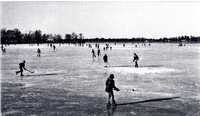 Lake Quannapowitt, 1969
 "Lake Quannapowitt, the center of recreational activities in Wakefield, drew scores of local youth to its shores during the winter months for skating and pick-up hockey games. Although winter 1969 was cold, the ice remained unsafe well into January, with Safety Officer Max Ramocki issuing a caution to residents of unsafe conditions. Despite several below-freezing days, the Lake was partially open in early 1969. This unusual pattern led to much speculation, and it was determined that the first theories - that vegetation controlling chemicals were responsible, and that the American Mutual building at the head of the Lake caused air currents - were not the case; rather, the winds that accompanied the cold temperatures caused the water to remain in motion. At the time, it was common for alerts to be issued by the Town about skating conditions and for parents to call the Police of Fire Department to see if the Lake was safe. The Department of Public Works was also called in many times to plow sections of the Lake near the boat ramp at Veterans' Field, for skaters."
-
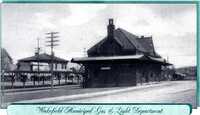 Upper depot, early 1900s
 "The Wakefield Real Estate and Building Association was listed as the owner of several properties in the late 1800s and early 1900s. The company owned the land between Chestnut and Murray Streets which was purchased for $15,000 by the Boston & Maine Railroad in 1888 to build a new station. The B&M started building its commodious structure in 1990; it was completed, and opened in 1890. In the background is North Avenue, formerly Railroad Avenue. It is interested to note the horse and buggies in front of the businesses and the Bank Building, near the center of the photo."
-
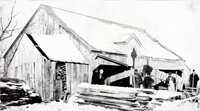 Bickford's saw mill, 1890
 "Bickford's Saw Mill was located on Vernon Street at the Lynnfield line."
-
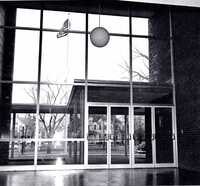 Wakefield Memorial High School, Main Street, circa 1955
 "Town Meeting voted in 1952 to build a new high school on Main Street next to the high school built in 1923. Wakefield Memorial High School opened in 1955 and was named to honor all those killed on the battlefield since the Civil War. The former high school, the Willard B. Atwell School, housed grades seven, eight and nine until the junior high school on Farm Street opened in December 1960 for grades seven and eight. The Willard B. Atwell building, which became part of the high school, was destroyed by fire in December 1971. Double sessions were held at Wakefield High School until a new high school was built on Farm Street in 1974. Wakefield Memorial High School was moved to Farm Street, and the junior high school, now the Galvin Middle School, moved to Main Street."
-
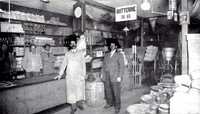 Atkinson's Grocery Store, 1912
 "Ira Atkinson owned Atkinson's grocery and grain store located in the 1890s at 470 Main Street. According to an advertisement in the publication Representative Business Men of Wakefield, published in the late 1890s, Ira Atkinson opened the store in 1874. It also noted that the store was one of the 'oldest and most complete of its kind in Wakefield', and that Atkinson had three assistants. Atkinson dealt in 'groceries of all kinds, flour and grain, choice teas, coffees, spices, etc.', and was 'in a position to supply these commodities in any desired quantity and bottom prices to both large and small buyers.' The store occupied a space of 100' x 25' with a storeroom that enabled Atkinson to carry a large and complete stock of the items mentioned, 'together with others of minor importance.' The ad also boasted that Atkinson guaranteed everything he sold and 'always paid once hundred cents on the dollar'. Among the items sold was Butterine a name for margarine that was most often made from animal fat such as pork lard or beef tallow. When first introduced in England in 1869, it was called butterine until the late 1880s. The use of the word 'butterine' continued longer in America. Note the wooden barrels and scales throughout the store, as well as the grinder."